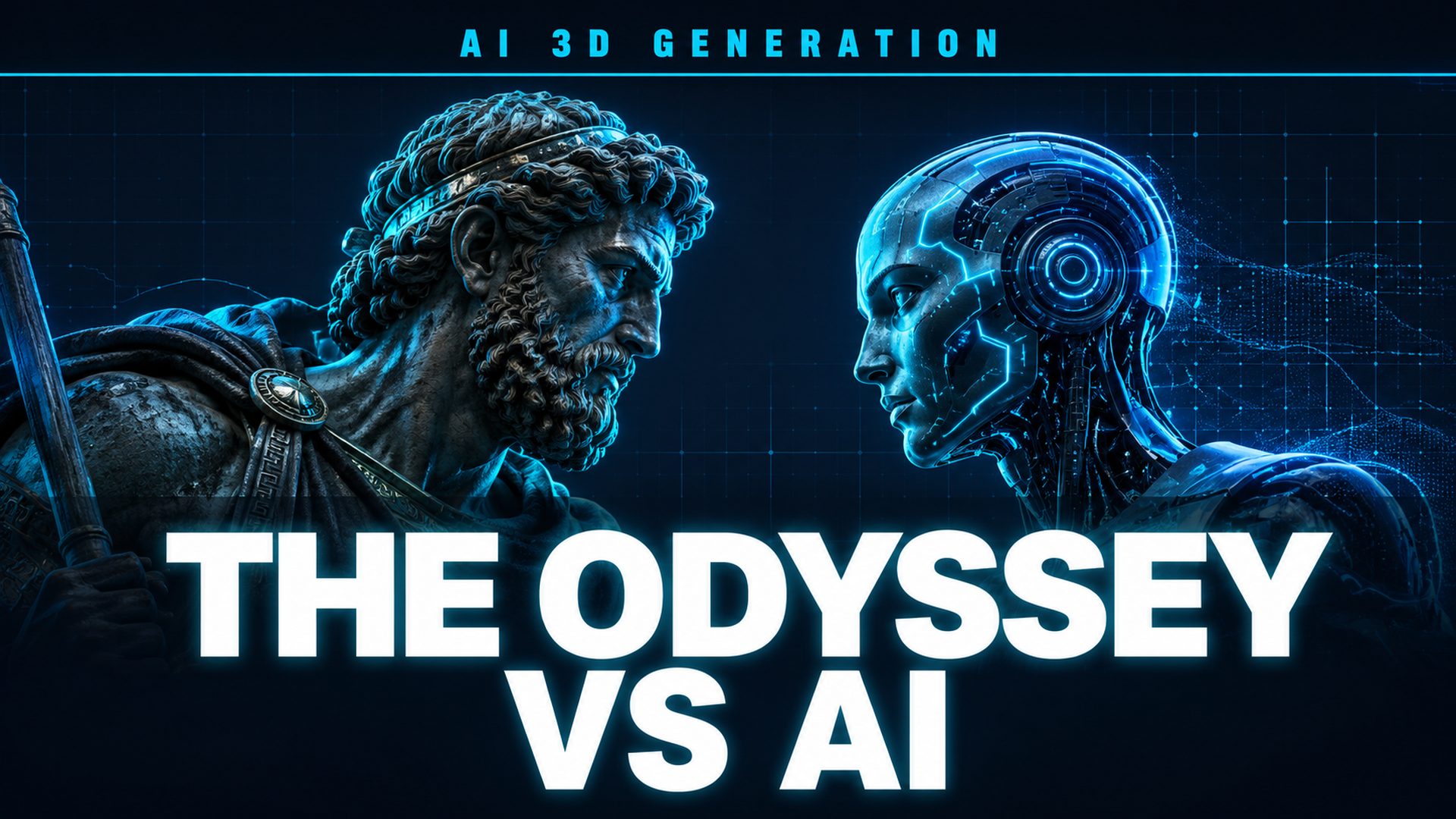
The Odyssey vs AI: Why Christopher Nolan Went Practical and AI 3D Is the Future
Quick Summary
- Christopher Nolan’s The Odyssey is the year’s biggest film, made almost entirely with practical effects and zero CGI.
- Elon Musk’s Grok Imagine and Fountain O’s Odysseus: The Fall represent two different AI-driven approaches to the same source material.
- Neural4D’s AI 3D generation technology gives indie creators the power to produce professional 3D assets without a Hollywood budget.
Christopher Nolan built a 60-foot Cyclops puppet for The Odyssey. Elon Musk wants Grok to remake the same story. The Odyssey vs AI debate is not theoretical. It is happening right now, and it has real implications for how 3D content gets made.
Contents
Part 1: Why Nolan’s Practical Approach Matters
Christopher Nolan’s The Odyssey opened on July 17, 2026 to an 8.4 IMDb rating and a $264 million global box office in its first week. Critics called it “colossal” and “a piece of cinema that demands the biggest screen possible.” The budget: $250 million. The CGI budget: near zero.
Nolan shot the entire film on IMAX 70mm film across six countries. Real ships built to ancient Greek specifications. Real weather in the Mediterranean. A real cave in Greece for the Cyclops sequence. The director’s philosophy was blunt: “We’re not doing the job right making a film of The Odyssey if it doesn’t seem difficult.” The Odyssey vs AI divergence in approach could not be more clearly drawn.
The Cyclops Was a 60-Foot Puppet
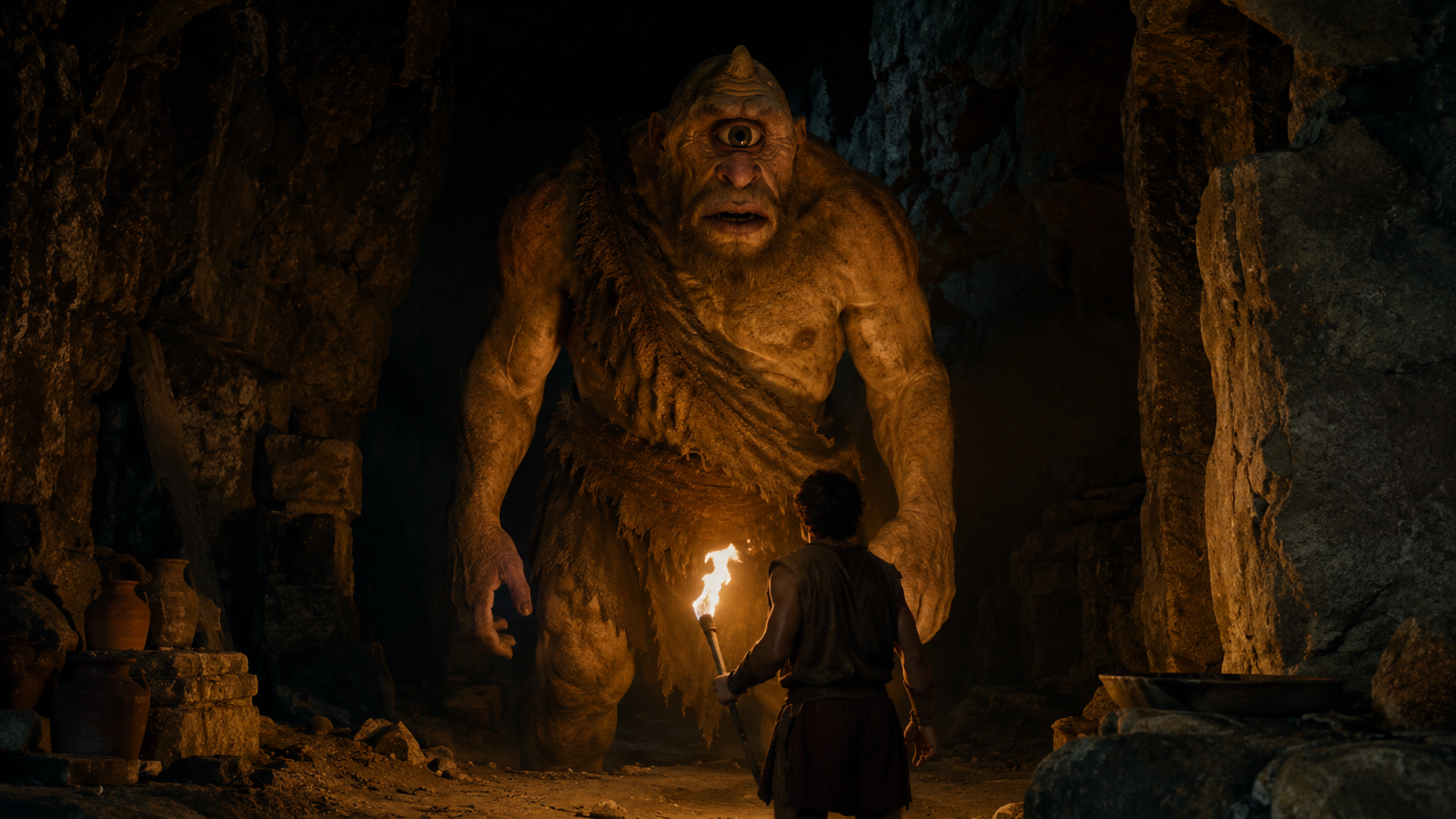
The most discussed scene in the film is Polyphemus the Cyclops. Rather than build a digital model, Nolan commissioned a 60-foot practical puppet operated by Bill Irwin (who previously puppeteered TARS in Interstellar). The creature’s movements, vocalizations, and physical presence were all performed live on set. Forced perspective shots and carefully placed camera angles sold the scale.
The Pig Transformation Was Animatronics
When Circe transforms Odysseus’s men into pigs, there is zero digital compositing involved. Samantha Morton manipulated an animatronic head on camera, physically sculpting the transformation in real time. Anne Hathaway, who was present during filming, admitted: “We were there and we still don’t know how it happened.”
The message from Nolan’s camp is unmistakable. Audiences can tell the difference between something physically real and something rendered. The Hollywood Reporter declared that the film’s box office proved “audiences want movies made the hard way.” The Odyssey vs AI question cuts to the heart of how stories will be visualized in the coming decade.
Part 2: The AI Counter-Narrative Arrives
While Nolan’s film dominated theaters, two very different AI-driven projects made headlines for reimagining the same Homeric epic.
Musk’s Grok Imagine Announcement
On July 22, 2026, Elon Musk announced that xAI’s Grok Imagine would produce a full-length “historically accurate” AI-generated Odyssey film by the end of the year. The announcement came with a 3-minute AI-generated clip showing Odysseus and Calypso. Critics and historians immediately pointed out the irony of claiming “historical accuracy” for a mythological poem, but the announcement drew massive attention to the question of whether AI could replicate a $250 million production for a fraction of the cost.
Fountain O’s Odysseus: The Fall
Independently, AI film studio Fountain O released “Odysseus: The Fall,” a 135-minute fully AI-generated feature. The budget: roughly $50,000, spent mostly on cloud computing credits for Kling AI video generation. The script and narrative were written by humans; the visuals were generated entirely by AI. Founder Ash Koosha described it as a “proof of concept for democratizing epic storytelling.” The film streams exclusively on Fountain0.com for a $9.99 rental.
These two projects sit at different ends of the AI spectrum. Musk’s announcement is speculative and provocative. Fountain O’s film is a shipped product, however experimental. Together they form a clear signal: the monopoly on large-scale visual storytelling is cracking. The Odyssey vs AI conversation now has evidence on both sides, and the gap between them is smaller than most expected.
Part 3: What the Odyssey vs AI Debate Means for Creators
The Odyssey vs AI conversation tends to frame the question as a binary: handmade authenticity versus machine efficiency. But for the working creator, the real question is different: what tools do I have access to, and what can they actually produce?
Nolan had $250 million, six countries, and a 60-foot puppet. Most creators have a laptop and a deadline. That is the gap that AI 3D generation is starting to fill.
The 3D Asset Problem
Whether you are building a game level, prototyping a product design, or preparing a 3D print, the bottleneck is the same: generating 3D content takes time. Professional modeling software like Blender or Maya requires hundreds of hours to master. Outsourcing to a 3D artist costs hundreds of dollars per asset. For indie developers, solo creators, and small studios, these barriers have historically made 3D content production prohibitively expensive.
AI-powered 3D model generation changes that equation. Instead of sculpting geometry vertex by vertex, a creator types a description or uploads a reference photo and receives a production-ready mesh in under two minutes. The technology does not replace the artist’s intent. It removes the mechanical overhead between an idea and a usable 3D asset. That is what makes The Odyssey vs AI framing so relevant to working creators.
| Approach | Cost | Time to First Asset | Accessibility |
|---|---|---|---|
| Nolan’s Practical Cyclops | $250M (entire film) | Months of construction | Studio level only |
| Traditional 3D Modeling | $200+ per asset | Days to weeks | Requires trained artist |
| Fountain O’s AI Film Pipeline | $50K (entire film) | Weeks of generation | Scripting + AI tools |
| Neural4D AI 3D Generation | Free to $18/month | ~90 seconds (base mesh) | Anyone with a text prompt |
Part 4: Where AI 3D Generation Fits in the New Landscape
In the Odyssey vs AI landscape, Neural4D occupies a pragmatic middle ground. Its Direct3D-S2 architecture, published at NeurIPS 2025, uses Spatial Sparse Attention (SSA) to deliver production-ready 3D geometry at roughly 12x the inference speed of industry-standard models. The technology was developed by research teams from Nanjing University, DreamTech, Oxford University, and Fudan University. The mission is straightforward: make high-quality 3D asset generation accessible to anyone.
Generating Mythological Assets from Text
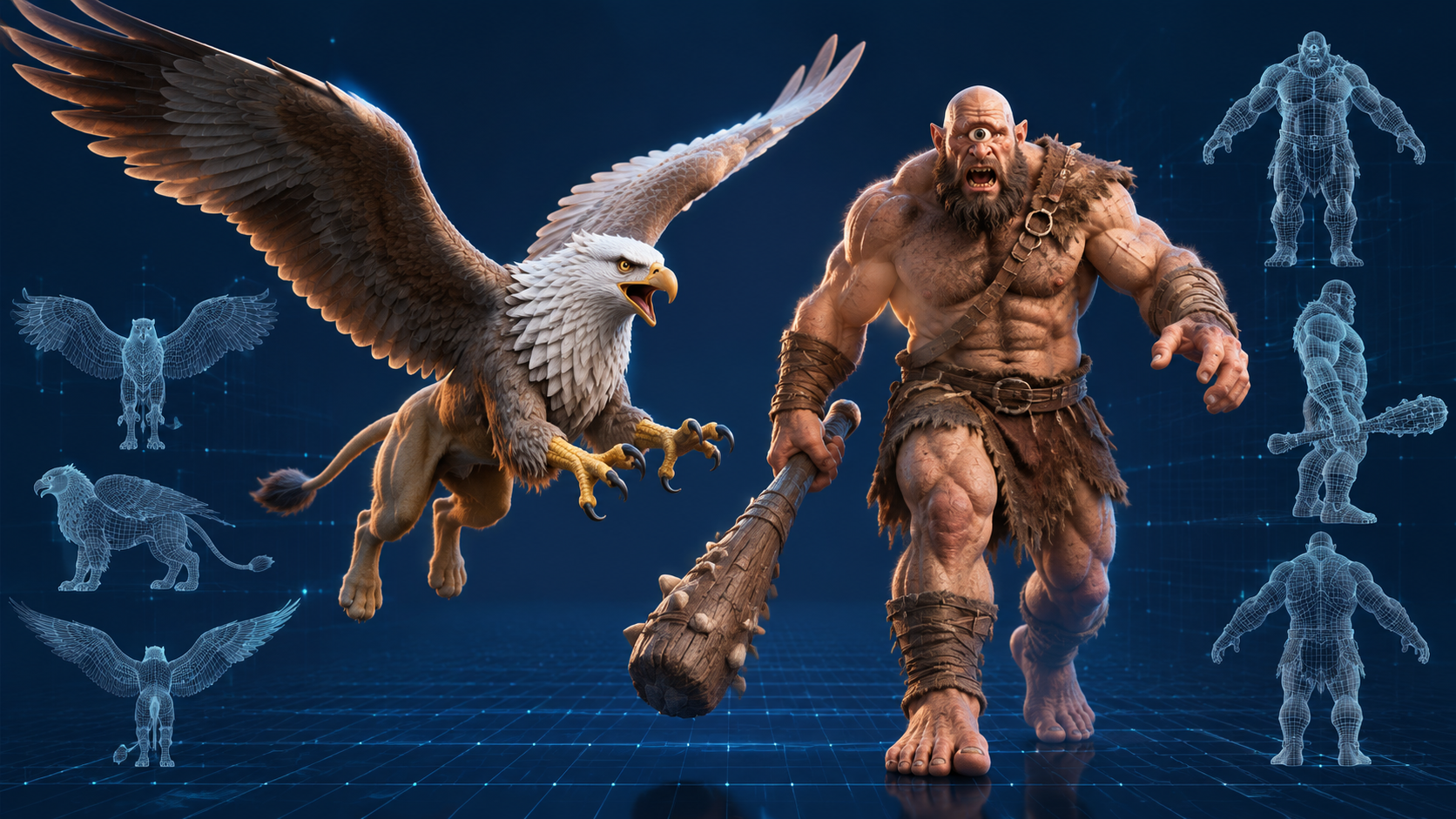
Imagine typing “a one-eyed Cyclops, textured, game-ready” into a text field and receiving a watertight mesh with PBR materials in under two minutes. That is not a concept. It is what Neural4D’s text to 3D model pipeline does today. The same engine can generate creatures, armor, props, environments, and characters that would have required a professional 3D artist days or weeks to produce.
The workflow follows a simple loop: input a text description or reference image, generate the base mesh at up to 2 million polygons, and export in .fbx, .glb, .obj, .usdz, .stl, or .blend format. For finer control, Neural4D-2o allows conversational editing of the generated model using natural language. Change the pose. Adjust the proportions. Swap the material. Each iteration takes seconds, not hours.
Real Use Cases Beyond the Buzz
The practical applications of this technology extend far beyond film-inspired fan projects. Game developers use Neural4D to prototype creature designs and environment props before committing to full production. 3D printing enthusiasts generate watertight STL files for tabletop miniatures and collectibles. Indie studios build asset libraries for their games at a fraction of traditional costs.
The parallel with Nolan’s approach is instructive. Nolan insisted on physical craftsmanship because he believes the audience feels the difference. AI 3D generation does not compete with that philosophy. It serves a different audience: the creator who cannot afford a 60-foot puppet but still wants to bring a Cyclops to life. In that sense, the Odyssey vs AI comparison reveals not a conflict but a continuum of access.
| Creator Type | Traditional Approach | With Neural4D |
|---|---|---|
| Indie Game Developer | Buy or outsource assets ($50-200 each) | Generate from text, iterate in minutes |
| 3D Printing Hobbyist | Download STL, hope it fits | Generate custom mesh, export watertight STL |
| Concept Artist | Sketch reference, hand off to modeler | Generate 3D base directly, refine in Neural4D-2o |
| Filmmaker (indie) | Practical props or expensive VFX | Generate 3D assets, animate in engine |
Bring Your Mythological Ideas to Life
Generate production-ready 3D models from text or images in under two minutes.
No credit card required. 50 free generations per week.
Part 5: Common Questions on The Odyssey vs AI
Q: Did Nolan use any digital effects at all in The Odyssey?
Yes, but minimally. The sea monster Scylla was rendered with CGI, and the giant whirlpool sequence required digital compositing. The Hollywood Reporter noted these effects were “moderate to fair” in quality, suggesting Nolan prioritized practical solutions wherever physically possible and reserved digital tools only for what could not be built.
Q: What was the reception of Fountain O’s AI-generated Odyssey film?
Odysseus: The Fall generated significant press for its technical ambition but received mixed reviews. Critics noted visible artifacts in character animation and inconsistent visual quality across scenes. The project is widely regarded as a proof of concept rather than a finished artistic work. It demonstrated that a full AI feature film is technically possible at a micro-budget, but the quality gap with Nolan’s production remains substantial.
Q: Can Neural4D generate game-ready mythological creatures?
Yes. Neural4D outputs clean topology with quad-dominant meshes and PBR materials (Normal, Roughness, Metallic maps). Export formats include .fbx, .glb, and .obj, all directly importable into Unity, Unreal Engine, and Godot. The AI Retopo feature ensures polygon counts stay within engine performance budgets. For game developers prototyping creature designs, Neural4D can generate a fully textured Cyclops, Griffin, or Minotaur in roughly 2 minutes.
Q: How does the cost of AI 3D generation compare to traditional outsourcing?
A single custom 3D character from a professional artist costs $200 to $800 and takes 1-3 weeks. Neural4D’s Pro plan costs $18 per month and includes 7,500 generation credits. The difference is not about quality. Professional artists deliver bespoke, art-directed results. AI generation provides speed and volume for prototyping, iteration, and projects where budget constraints would otherwise force a 2D-only approach.
Q: Is AI 3D generation suitable for 3D printing?
Neural4D’s Direct3D-S2 engine outputs watertight, manifold geometry by default, which means models export as closed STL files ready for slicing software. There is no need to manually patch holes or repair non-manifold edges before printing. This is a significant advantage over some competitor tools that produce open meshes requiring post-processing in Blender or Netfabb before they can be printed.
Q: Why does The Odyssey vs AI debate matter for 3D creators specifically?
The Odyssey vs AI debate crystallizes a question every 3D creator faces: do you invest in traditional craftsmanship or adopt AI-powered workflows? Nolan’s approach proves there is enduring value in hands-on making. But the AI alternatives demonstrate that speed and accessibility have their own creative power. For 3D creators, the practical takeaway is that both approaches have a place in a modern pipeline. Tools like Neural4D offer a way to access the speed of AI generation without sacrificing the control that makes crafted assets valuable.
Q: How do AI-generated 3D assets handle licensing for commercial projects?
Neural4D grants full commercial use rights to paid subscription holders. Free tier outputs are marked as trial versions and intended for testing only. For game developers and indie studios building commercial products, upgrading to a Pro plan ensures all generated assets can be used in shipped titles without royalty obligations. The Enterprise API tier adds custom licensing and SLA guarantees for larger production pipelines.
Try Neural4D and Start Creating in 3D
The Odyssey vs AI debate is not going to settle in one direction. Nolan will keep building practical sets. Musk will keep promising AI-generated epics. But for the vast number of creators who just want to make something, the arrival of production-grade AI 3D generation is the real story.
Neural4D’s text to 3D and image to 3D tools put professional-quality 3D asset creation within reach of anyone with an idea. Whether you are prototyping a mythological creature for a game, preparing a custom model for 3D printing, or building an asset library for an indie film project, the pipeline works the same way: describe what you want, and let the Direct3D-S2 engine handle the geometry.
The barrier between imagination and a usable 3D asset has never been lower.
Start Creating in 3D Today
Generate, edit, and export 3D models with Neural4D. Free to start.
No credit card required. 50 free generations per week. Pro from $18/month.
External source: The Hollywood Reporter analysis on The Odyssey’s practical effects box office impact