How to Fix Broken CAD Geometry for Digital Twins with AI: The Definitive Industrial Guide
Quick Summary
- Broken CAD geometry leads to simulation failures due to non-manifold edges and gaps in digital twins.
- Neural4D Direct3D-S2 automates repair by reconstructing volume using neural signed distance functions.
- Industrial digital twins require watertight manifold sovereignty for accurate physics and CFD solving.
- The Neural4D 2.5 workflow introduces iterative refinement, reducing preparation time by 99%.
- AI-driven geometry fixes eliminate the scalability bottleneck of manual engineering cleanup.
Modern industrial digital twins rely on high-fidelity structural integrity to predict real-world performance, making it essential for engineers to understand how to fix broken CAD geometry for digital twins with AI. By shifting from manual B-rep patching to automated neural reconstruction, organizations can transform unstable legacy files into simulation-ready manifold assets in seconds.
Part 1: The High Cost of Geometry Errors in Industrial Digital Twins
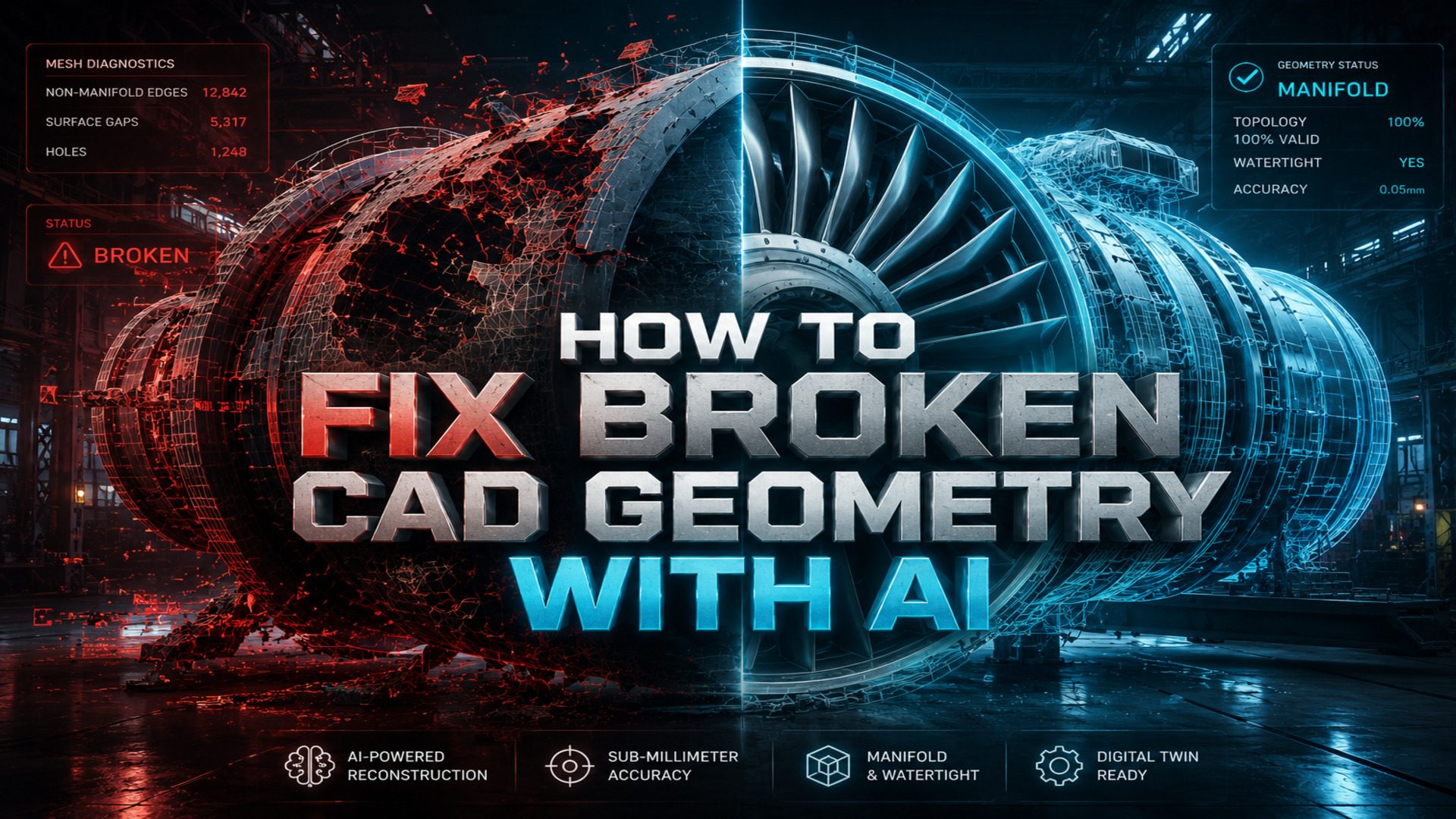
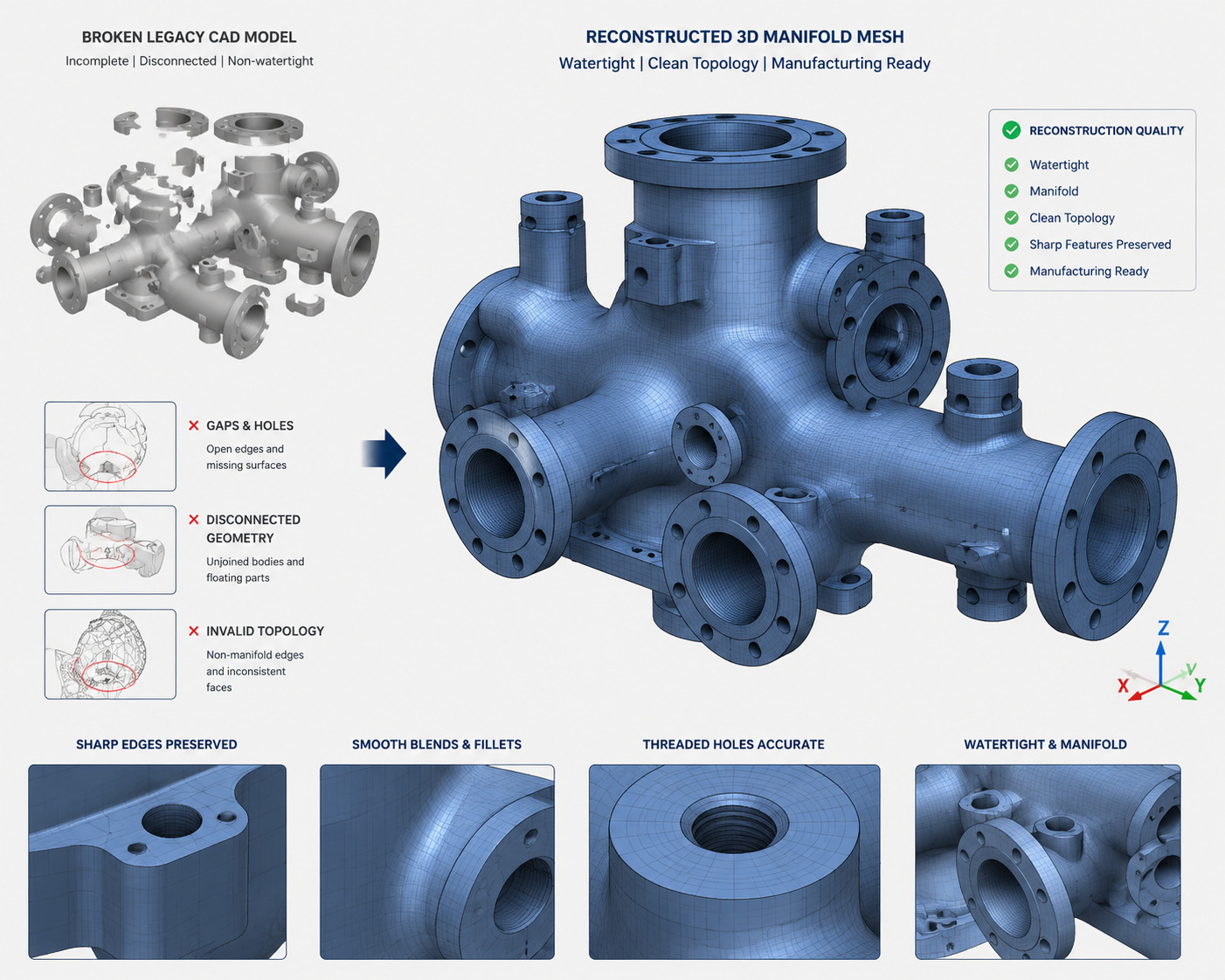
A digital twin is a mathematical representation of a physical asset, but its utility is directly capped by the topological integrity of its mesh. When CAD data is exported from legacy PLM systems or converted across proprietary formats, the resulting geometry often arrives “broken”, characterized by non-manifold edges, self-intersections, and microscopic gaps between surfaces.
These defects are not merely aesthetic; they are catastrophic for high-fidelity simulation. Physics engines and Finite Element Analysis (FEA) solvers require a strictly defined boundary between “inside” and “outside” volume. If a mesh has a 0.001mm gap, a Computational Fluid Dynamics (CFD) solver will treat it as a pressure leak, causing the simulation to diverge or fail to initialize entirely.
Recent industry surveys indicate that engineering teams spend approximately 30% to 50% of their total simulation time on “geometry cleanup” rather than analysis. For a mid-sized automotive project, this translates to thousands of wasted man-hours and delayed factory commissioning cycles.
Furthermore, broken geometry leads to “Simulation Drift”, where the virtual model’s behavior deviates from physical reality due to structural inaccuracies. This undermines the primary goal of the digital twin: predictive maintenance and operational optimization. Without watertight integrity, the digital twin remains an expensive 3D visualization rather than a functional engineering tool.
Part 2: Why Traditional B-rep Repair Tools Fail at Scale
Traditional CAD repair tools operate on Boundary Representation (B-rep) logic, attempting to “stitch” surfaces together using heuristic-based tolerance algorithms. While this approach was sufficient for simple mechanical parts a decade ago, it fails spectacularly when confronted with the complexity of modern industrial assets.
B-rep kernels rely on explicit topology. If a file contains overlapping faces or divergent vertex normals, traditional software often creates “Franken-geometry” — patches that look correct but harbor hidden floating-point errors. These errors often manifest as “invisible defects” that crash modern industrial platforms like NVIDIA Omniverse or Siemens NX during high-load rendering or simulation.
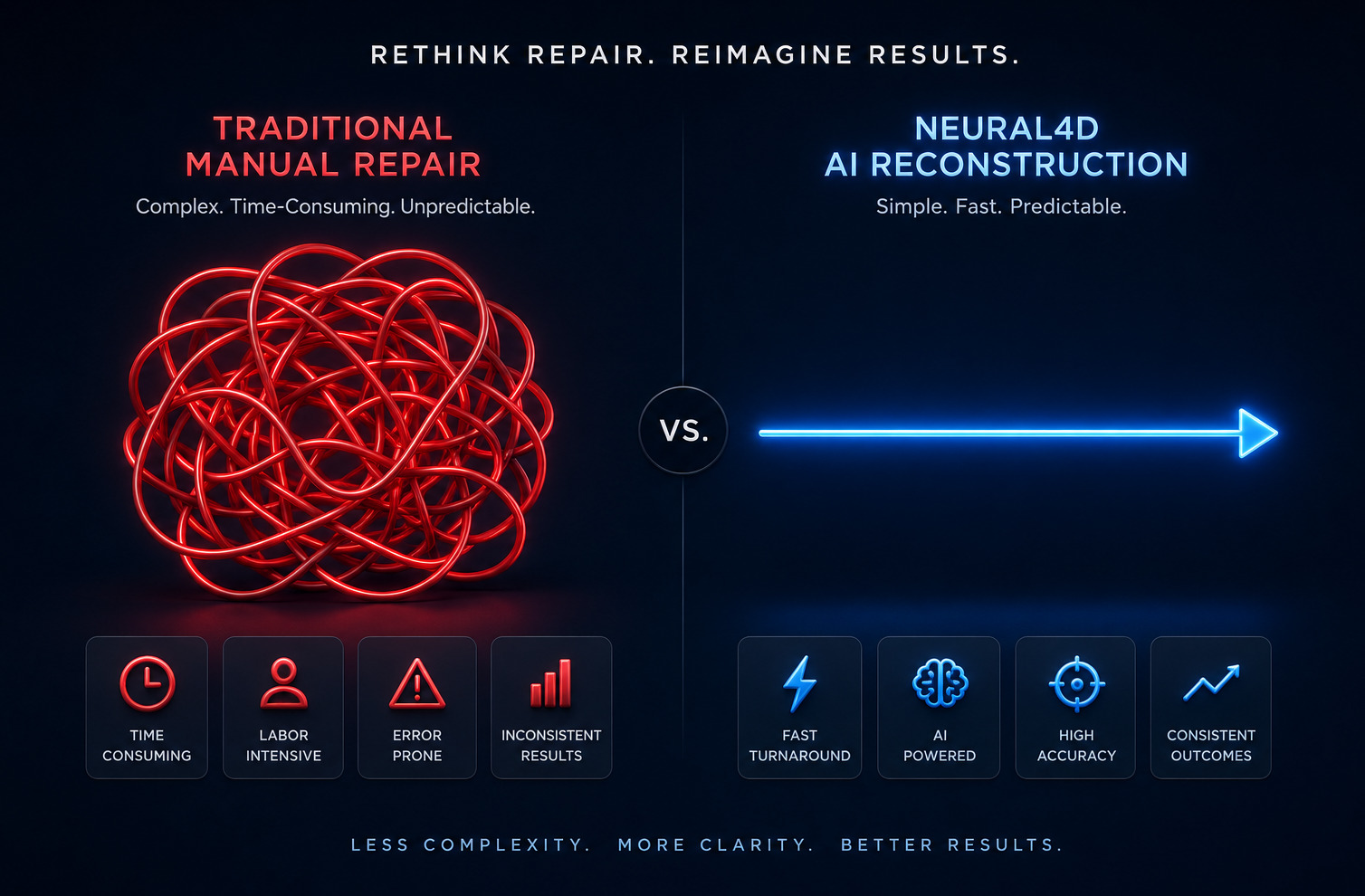
Traditional tools use heuristics (if-then rules) to bridge gaps, which often requires manual parameter tuning for every single part. Neural4D uses probabilistic reconstruction, treating geometry as a continuous volume rather than a collection of fragile surface patches.
The primary issue with legacy repair is scalability. If an enterprise needs to generate 10,000 digital twin assets for a smart factory, manual B-rep repair becomes a physical impossibility. The “trial and error” loop of adjusting stitching tolerances for each asset creates a massive bottleneck in the digital transformation pipeline.
Automate Your 3D Asset Pipeline.
Don’t let broken CAD geometry stall your digital twin project. Neural4D delivers watertight, simulation-ready meshes in 90 seconds.
Start Generating Manifold 3D Now
No credit card required. Weekly credit refills included for all creators.
Part 3: Direct3D-S2: Reconstructing Manifold Sovereignty via AI
Neural4D addresses the broken geometry crisis through its proprietary Direct3D-S2 architecture. Unlike traditional software that tries to fix existing surfaces, Direct3D-S2 uses a Neural Signed Distance Function (SDF) to reconstruct the entire volume from the inside out. This mathematical shift ensures that the output is fundamentally closed and manifold.
The S2 engine maps the input (even noisy or incomplete CAD data) into a continuous latent space. It then synthesizes a new geometry that follows the semantic “intent” of the original part while enforcing watertight constraints. This process effectively “re-dreams” the geometry into a High-Quality Triangular Mesh that is surgically precise.
The Power of Topological Loss Functions
A key technical differentiator of Neural4D is the use of Topological Loss Functions during the generation process. These algorithms penalize the AI for creating non-manifold edges or internal “floating” geometry. The result is Manifold Sovereignty: a state where every edge is shared by exactly two faces, ensuring the mesh is physically robust for any industrial software stack.
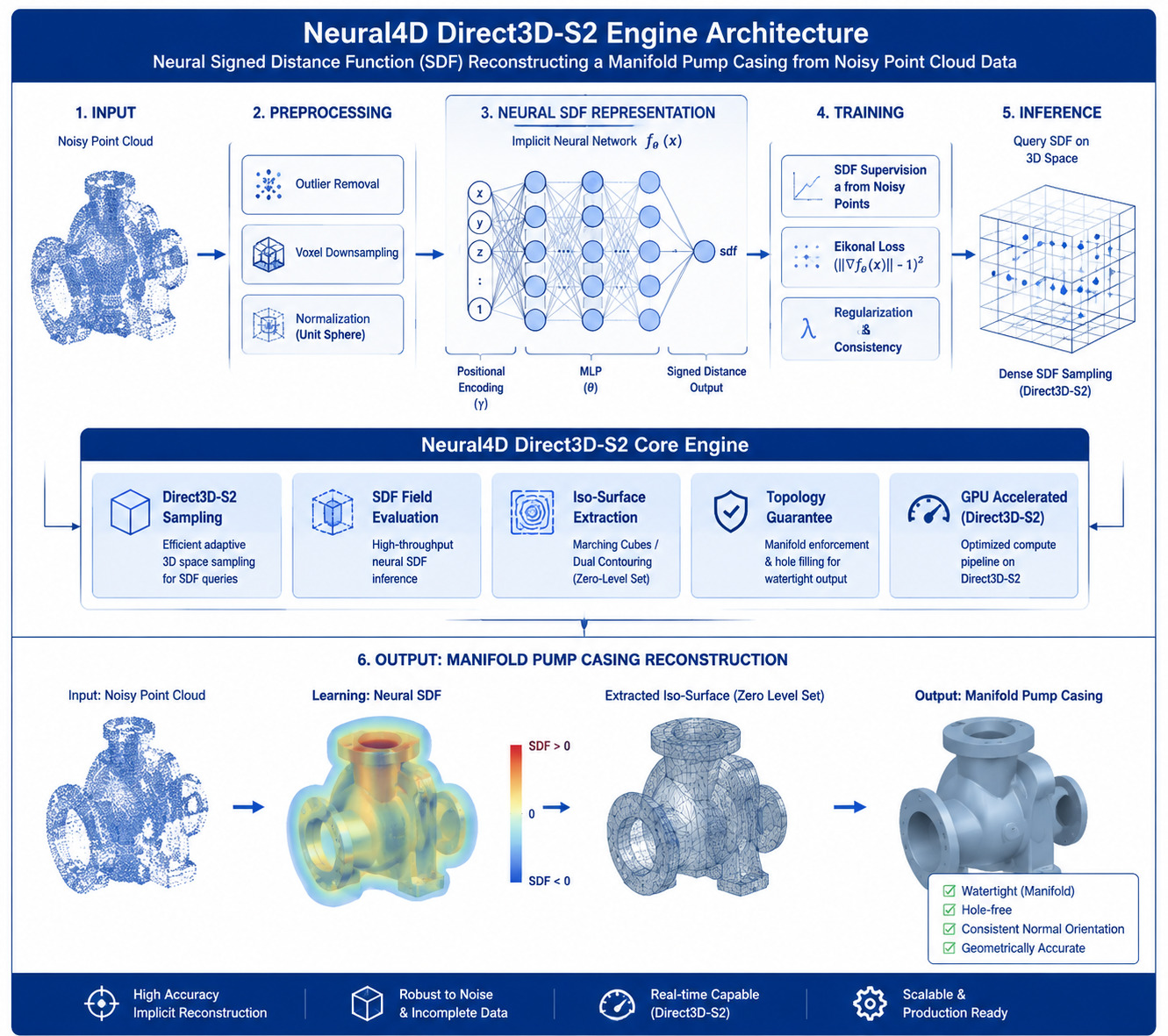
By operating in a continuous field rather than a discrete vertex space, Direct3D-S2 can resolve self-intersections that would typically take a human engineer hours to unwrap. The AI understands the functional form of industrial components (pumps, valves, gears) and reconstructs them with the correct mechanical logic.
Part 4: The Neural4D 2.5 Workflow: Iterative Reconstruction and Semantic Infilling
With the release of **Neural4D 2.5**, the platform introduces a specific iterative workflow designed for high-stakes industrial applications. This workflow moves beyond “one-shot” generation, allowing engineers to guide the AI through complex reconstruction tasks.
The Neural4D 2.5 loop consists of three primary phases:
- 1. Input Analysis: The AI identifies broken regions, gaps, and semantic holes in the original CAD file or scan.
- 2. Neural Generation: Direct3D-S2 generates a base mesh in ~90 seconds, performing semantic infilling to restore missing mechanical details.
- 3. User-Guided Refinement: The engineer can “mask” specific areas for higher-density mesh detail or use text prompts to adjust the topology (e.g., “increase vertex density on the flange surfaces”).
In many digital twin projects, parts are reconstructed from noisy LiDAR scans. If a sensor reflection causes a “hole” in a motor housing, Neural4D’s semantic engine understands that a motor housing must be a continuous, closed surface and automatically “heals” the missing data using its training on millions of industrial assets.
This iterative loop ensures that the final export is not just “good enough” for visualization, but technically verified for simulation deployment. The AI handles 99% of the heavy lifting, while the engineer retains sovereign control over critical dimensional tolerances.
Part 5: Benchmarking Industrial Compatibility: From 90-Second Meshes to Omniverse Deployment
The speed of Neural4D is a radical departure from traditional timelines. Base mesh generation takes approximately 90 seconds, while texturing and material mapping occur in parallel or subsequent passes. For enterprise operations, this enables the batch-repair of entire factory lines in a single afternoon.
| Feature | Manual CAD Repair | Neural4D AI Reconstruction |
|---|---|---|
| Time per Asset | 4 – 12 Hours | ~90 Seconds |
| Manifold Status | Manual verification required | Guaranteed by Direct3D-S2 |
| Mesh Standard | Inconsistent B-rep patches | High-Quality Triangular Mesh |
| Scalability | Staff-dependent | API-scalable (Thousands/hr) |
The resulting High-Quality Triangular Mesh is optimized for modern GPU architectures. Unlike quad meshes which can be unstable during automated decimation, triangular meshes provide the highest level of stability for Real-Time Simulation in platforms like Unreal Engine 5.4 and NVIDIA Omniverse. Neural4D ensures uniform vertex distribution, which is critical for preventing artifacts in physics-based rendering (PBR).
Part 6: FAQ: AI-Driven Geometry for Industrial Digital Twins
B-rep defines a part by its surface boundaries, which are fragile and prone to gaps. A Neural SDF defines a part by its volume, using a neural network to represent the distance to the surface, which inherently guarantees a closed, watertight output.
Yes. The Direct3D-S2 engine is designed to handle noisy “3D garbage” from photogrammetry or LiDAR. It maps the noisy input to a clean manifold latent space, effectively filtering out sensor noise and self-intersections.
Absolutely. Neural4D exports to standard industry formats (GLB, OBJ, STL). Since the meshes are watertight and manifold, they can be imported into CFD and FEA solvers with minimal pre-processing.
Yes. The 2.5 update allows for the processing of multi-part assemblies. The AI can reconstruct individual components while maintaining the correct spatial relationships and interfaces between parts.
Conclusion: Unlocking Scalable Digital Transformation with Neural4D
The bottleneck of digital twin adoption is no longer the simulation software itself, but the preparation of the 3D data. By mastering how to fix broken CAD geometry for digital twins with AI, engineering teams can shift their focus from tedious manual labor to high-value industrial analysis. With the power of Direct3D-S2 and the iterative Neural4D 2.5 workflow, the path from broken legacy data to a perfectly functional industrial metaverse is now shorter than ever before.
Scale Your Industrial Metaverse.
Join thousands of industrial leaders using Neural4D to automate their digital twin pipelines.
High-throughput API access available for large-scale asset generation.