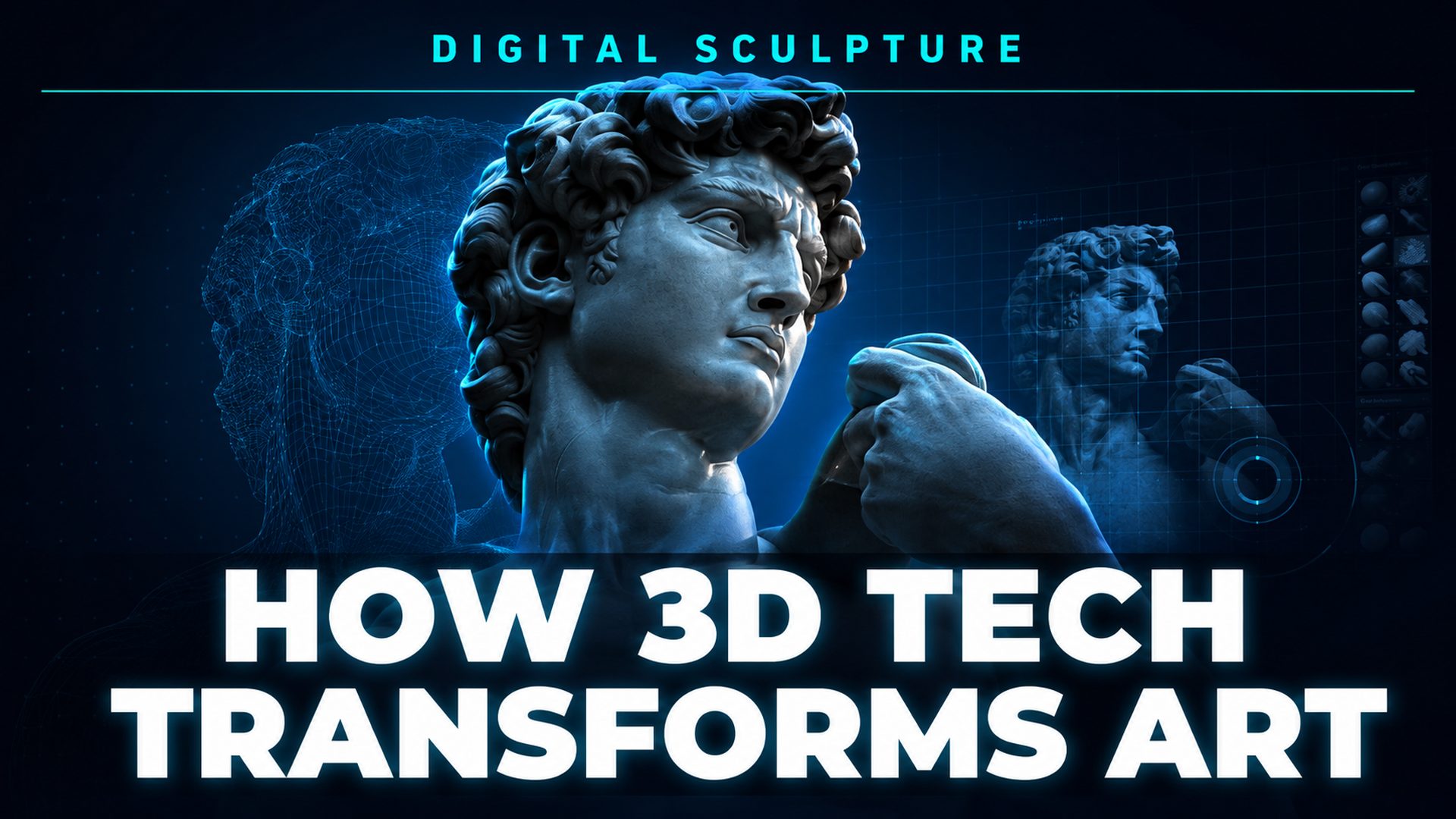
How Digital Sculpture Technology Transforms 3D Art: The Complete Guide
Quick Summary
- Digital sculpture refers to the use of 3D modeling software, AI generation, 3D printing, and 3D scanning technologies to create, modify, and fabricate sculptural works in a virtual environment before physical realization.
- ZBrush and Blender remain the dominant digital sculpting tools, with ZBrush handling up to 10 billion polygons for micro-detail work and Blender offering a free all-in-one pipeline for hard-surface and stylized models.
- AI generative design through diffusion models and GANs has introduced a new paradigm where sculptural concepts emerge from text prompts or 2D images in minutes rather than days.
- Neural4D’s Direct3D-S2 engine generates watertight, manufacturing-ready base meshes from a single photo or text description, integrating directly into ZBrush, Blender, or 3D printing workflows.
The convergence of 3D modeling, artificial intelligence, and additive manufacturing has fundamentally altered how sculptors conceptualize, design, and produce their work. Digital sculpture is no longer a niche subcategory of art; it is the central methodology driving modern sculptural practice across fine art, commercial production, and cultural heritage preservation.
Table of Contents
- Part 1: The Evolution from Traditional to Digital Sculpture
- Part 2: The Four Pillars of Digital Sculpture Technology HOT
- Part 3: AI’s Expanding Role in Sculpture Design and Production
- Part 4: 3D Printing: The Bridge Between Digital and Physical
- Part 5: 3D Scanning and Cultural Heritage Preservation
- Part 6: Common Questions on Digital Sculpture Technology
- Conclusion: The Digital Future of Sculpture
Part 1: The Evolution from Traditional to Digital Sculpture
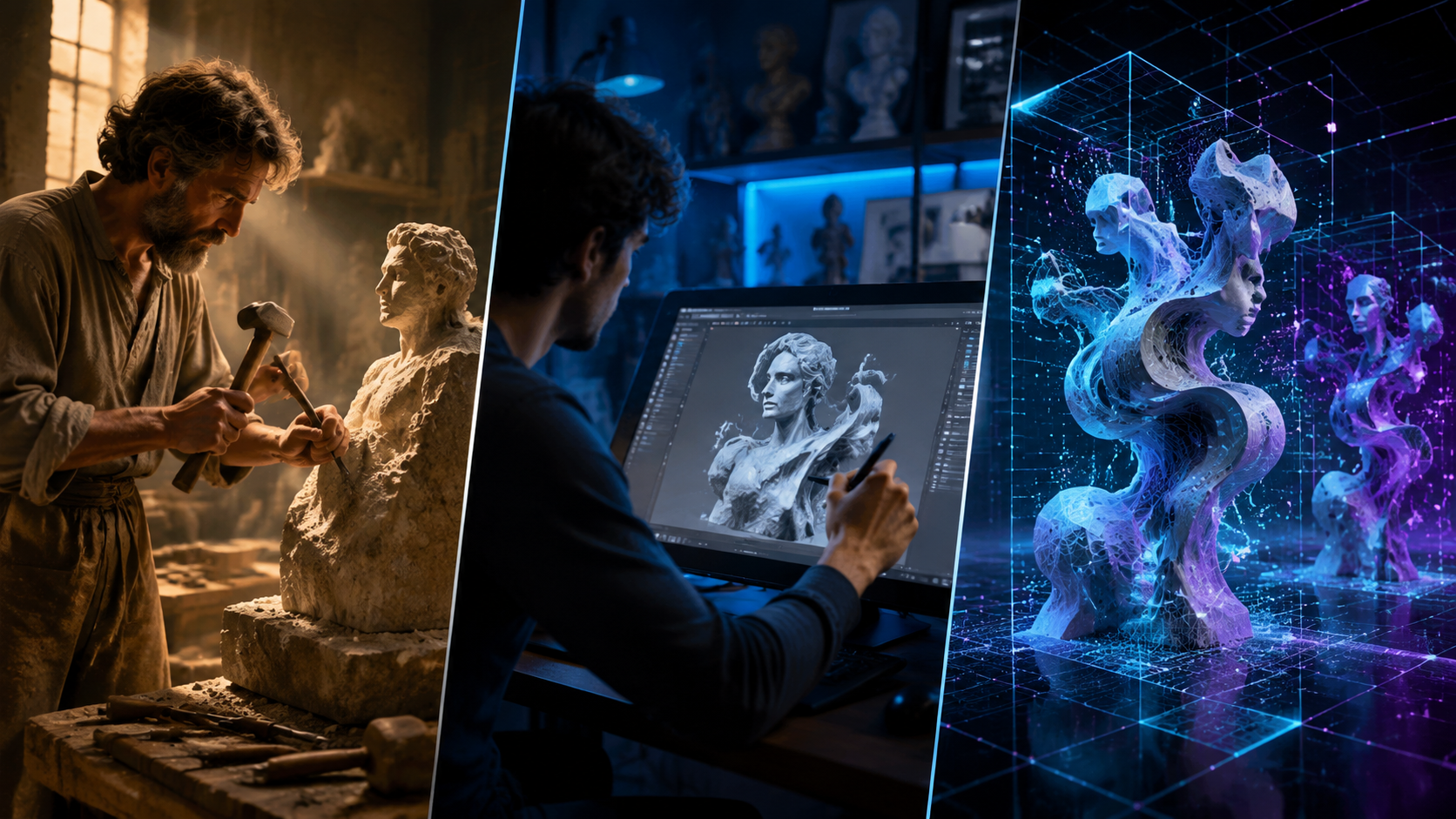
The digitization of sculpture has progressed through three distinct phases over the past three decades. Understanding this trajectory is essential for grasping where the field stands today.
Phase One: Tool Substitution (1990-2000). Digital tools entered sculpting as direct replacements for physical implements. Artists used early CAD software and the first versions of ZBrush primarily as efficiency aids, refining forms in virtual space to reduce material waste. The creative model remained artist-led with technology assuming a purely assistive role. Traditional clay sculpting techniques were replicated in software, not reimagined.
Phase Two: Media Consciousness (2001-2015). Digital sculpture developed its own aesthetic vocabulary. Features like infinite undo, non-destructive workflows, and the ability to output across multiple media (3D printing, AR/VR) were recognized as unique advantages rather than mere substitutes. Artists began exploring what digital clay could do that physical clay could not, including parameterized deformation and real-time symmetry. This period saw the rise of ZBrush as an industry standard and the emergence of Blender as a viable free alternative.
Phase Three: Cultural Integration (2016-Present). Machine learning technologies, including generative adversarial networks (GANs) and diffusion models, began empowering sculpture creation at the conceptual level. Tools like Blender AI Library Pro and specialized AI carving platforms introduced new theoretical concepts such as algorithmic form generation and AI-assisted topology optimization. The threshold for creating a 3D sculpture concept dropped from days to minutes, fundamentally altering the relationship between artist and tool.
Part 2: The Four Pillars of Digital Sculpture Technology
Digital sculpture rests on four interconnected technology pillars. Each addresses a distinct stage of the sculptural workflow, and their convergence is what enables the transformation currently underway in the field.
Professional applications like ZBrush and Blender provide the virtual workspace where artists manipulate digital clay with sub-millimeter precision. ZBrush handles up to 10 billion polygons for micro-detail work. Blender offers an integrated pipeline including sculpting, retopology, UV mapping, and rendering at zero licensing cost. These tools remain the primary interface between the artist’s hand and the digital form.
Mature
Diffusion models and GANs generate complete sculptural concepts from text descriptions or 2D reference images. Platforms like Neural4D convert a single photo into a watertight 3D mesh in roughly 90 seconds (base mesh) or 2 minutes or more with full PBR textures. This dramatically accelerates the concept-to-base-mesh phase of the sculptural workflow.
Rapidly Maturing
Additive fabrication converts digital sculptural data into physical objects using materials ranging from standard PLA and resin to bronze-infused filament and lost-wax casting. Modern printers achieve layer resolutions as fine as 25 microns, making production-grade sculpture fabrication accessible outside traditional foundries.
Mature
High-fidelity scanning captures existing sculptures with sub-millimeter accuracy, creating digital replicas for preservation, analysis, or remixing. Photogrammetry techniques reconstruct 3D geometry from overlapping 2D photographs, while structured light scanning captures finer surface details with error rates under 3%.
Mature
Digital Sculpting Software in Practice
ZBrush remains the professional standard for high-detail organic sculpting. Its brush engine supports over 200 customizable brushes and can manipulate models up to 10 billion polygons without performance degradation, a requirement for film and AAA game character sculpting where every pore and wrinkle must be legible at close range. Blender, in contrast, offers a comprehensive all-in-one environment that includes sculpting, hard-surface modeling, retopology, animation, and rendering. For artists producing 3D printed sculpture, Blender’s integrated QuadRemesh and STL export tools eliminate the file-format switching that fragments workflows in other pipelines.
The most common professional workflow combines both tools: Blender for base mesh creation, hard-surface elements, and topology optimization, then ZBrush for fine detail sculpting. For artists working with 3D sculpting software for the first time, Blender represents the lowest-risk entry point given its free license and extensive tutorial ecosystem. For a broader comparison of available tools, see our guide to the best 3D modeling tools compared.
AI Generative Design in the Sculptural Pipeline
AI generation has introduced a paradigm shift in the early stages of sculpture creation. Rather than starting from a digital sphere and manually extruding every form, artists can now generate a fully formed base mesh from a text prompt or reference photo in seconds. AI image to 3D model generation, powered by Neural4D’s Direct3D-S2 architecture (published at NeurIPS 2025), reconstructs complex geometry from a single 2D image. The output is a watertight mesh ready for import into ZBrush or Blender for refinement.
This does not eliminate the sculptor’s role. The AI-generated mesh is a starting point, a rough-hewn block that the artist refines with traditional digital sculpting techniques. What changes is the speed of the rough-in phase. A base mesh that previously required 10 to 40 hours of manual work can now be generated in 2 to 5 minutes, freeing the artist to focus on creative expression rather than repetitive geometry construction.
3D Scanning as an Input Method
For sculptors working with physical reference objects, 3D scanning bridges the gap between the analog and digital worlds. Structured light scanners capture surface detail at sub-millimeter resolution, while photogrammetry reconstructs geometry from standard camera equipment. A sculptor can scan an existing clay maquette, import the mesh into digital sculpting software for refinement, and output the final version through 3D printing or CNC milling. This closed-loop workflow was unavailable before the convergence of these four technology pillars.
Turn Any Image into a Sculptural Base Mesh
Upload a reference photo and let Neural4D generate a watertight 3D model in minutes. Import the mesh directly into ZBrush or Blender for refinement.
50 free credits every week. No credit card required to start.
Part 3: AI’s Expanding Role in Sculpture Design and Production
AI’s involvement in sculpture extends beyond base mesh generation. Modern machine learning models participate in the creative process at multiple levels, from concept exploration to surface detail optimization.
From GANs to Diffusion Models
Generative adversarial networks demonstrated that machine learning could produce visually compelling sculptural forms. The first GAN-generated artwork sold at auction for $432,500, establishing a market for AI-assisted sculpture. Diffusion models, including the CLAY architecture developed by ShanghaiTech University, advanced the field further by integrating multi-resolution variational autoencoders with diffusion transformers to generate detailed 3D objects directly from text descriptions or 2D images. These models produce geometry that respects physical plausibility: closed surfaces, structural continuity, and coherent proportions, all without requiring the artist to define these constraints manually.
For sculptural applications, the practical value lies in exploration. An artist can input a brief text description such as “abstract human figure, wind-swept pose, rough stone texture” and receive multiple unique 3D interpretations within minutes. This amplifies the artist’s ability to iterate on conceptual directions before committing hours of manual labor to a single approach. Research on AI-assisted sculpture production demonstrates that this approach achieves high aesthetic novelty ratings (4.6 out of 5) and form complexity (4.3 out of 5) while maintaining fabrication feasibility through parametric regulation that reduces mesh defects by 88%.
Human-AI Collaboration Models
The industry has converged on three distinct collaboration frameworks. In the artist-led model, the sculptor directs creative decisions while AI handles modeling, retopology, and rendering tasks. The equal-collaboration model relinquishes partial control to the AI, with the artist defining parameter bounds and the algorithm exploring the form space within those limits. In the AI-driven model, the system generates numerous design proposals and the artist curates, refines, or combines them. Each model suits different phases of the sculptural workflow, and experienced practitioners move between them based on the specific task at hand.
A notable development is the use of aesthetic energy functions, where the AI optimizes sculptural forms against mathematically defined beauty criteria. The MetaSculptor system, for example, employs simulated annealing and gradient descent to explore millions of form variations in a three-hour session, producing results that blend stylistic references from Baroque and cyberpunk visual languages. The AI sculpture generator category is expanding rapidly, but current systems function most effectively as collaborative partners rather than autonomous creators.
📊 Market Context The Chinese digital sculpture market exceeded 50 billion RMB in 2025, with projections reaching 500 billion RMB by 2030. AI generation and 3D printing technologies are the primary growth drivers, with the largest adoption occurring in commercial sculpture production, cultural tourism, and architectural decoration sectors. This growth trajectory reflects the broader integration of digital tools into what was historically a purely manual craft, as documented in recent comprehensive surveys of the field (Art Between Matter and Code, Springer 2026).
Part 4: 3D Printing: The Bridge Between Digital and Physical
Digital sculpture exists in virtual space until it is fabricated. 3D printing, also called additive manufacturing, is the technology that translates digital data into physical objects, making it an indispensable component of the digital sculpture pipeline.
Material Options for Sculpture Fabrication
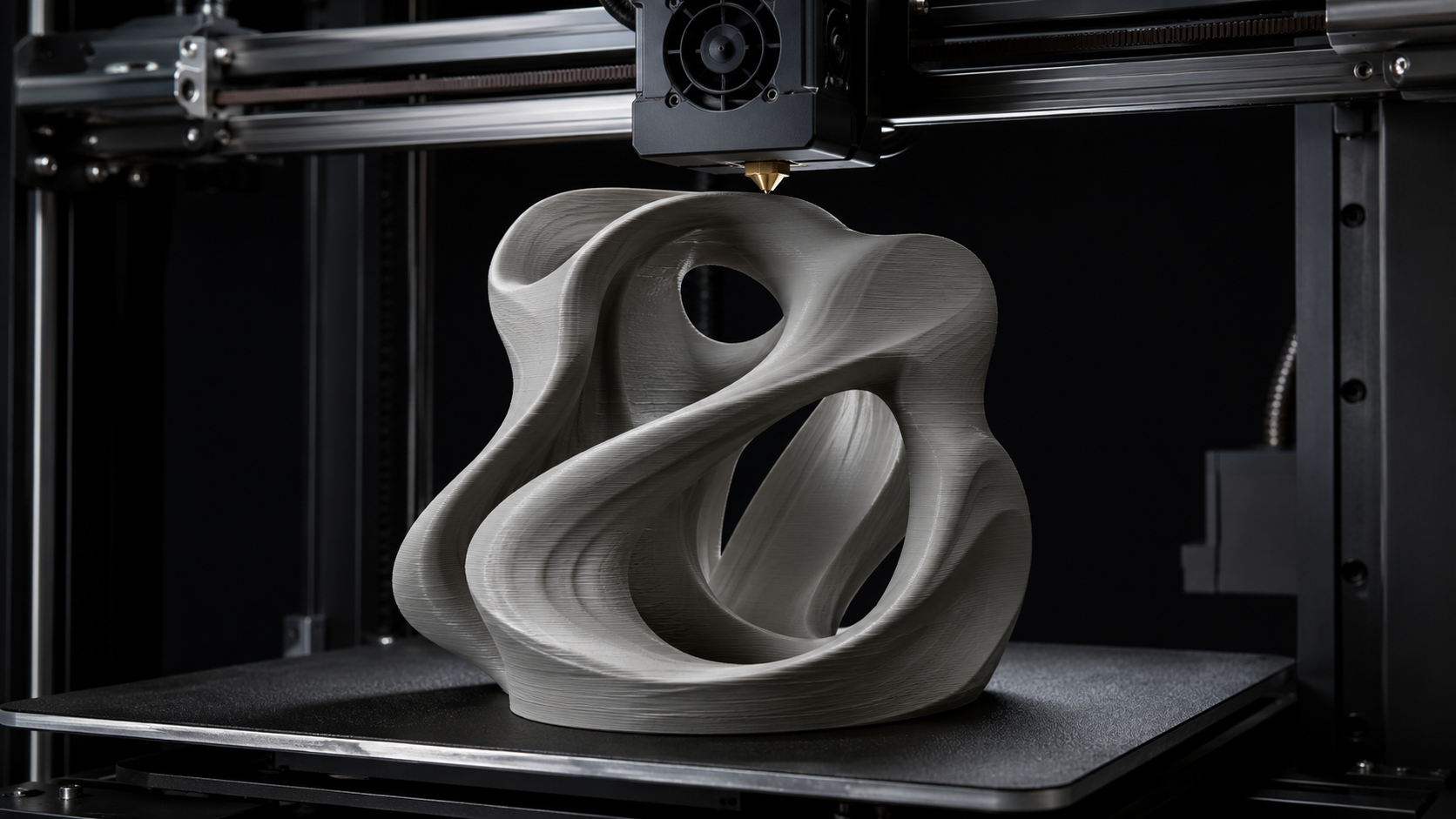
Modern 3D printing supports a wide range of materials suitable for sculpture. Standard thermoplastics (PLA, PETG) offer low-cost iteration for prototyping form and scale. Resin-based printing delivers the highest detail resolution, with layer heights as fine as 25 microns, making it the preferred choice for figurines, maquettes, and small-scale art objects. For permanent or outdoor 3D printed sculpture, advanced materials such as stone-infused PLA, metal-filled filaments, and UV-resistant photopolymers produce durable results. Bronze, aluminum, and even stainless steel can be printed directly through binder jetting or used in lost-wax casting workflows where a 3D printed positive is invested in ceramic shell and cast in molten metal.
From Digital File to Physical Object
The fabrication workflow for 3D printed sculpture follows a consistent sequence. The artist completes the digital model in sculpting software, exports it as an STL or OBJ file, and processes it through slicing software that converts the 3D geometry into machine instructions (G-code). The printer deposits material layer by layer to reconstruct the digital form in physical space. For large-scale sculptures, the model is divided into interlocking segments, printed separately, and assembled post-fabrication. Post-processing steps including sanding, priming, painting, or patina application complete the transition from digital data to finished artwork.
The critical requirement for successful 3D printed sculpture is watertight geometry. Any hole or non-manifold edge in the digital model produces a print failure. This is where AI-generated meshes from systems like Neural4D offer a structural advantage: the Direct3D-S2 engine outputs mathematically watertight meshes that load directly into slicing software without manual repair. For artists producing 3D sculpture printing outputs, Neural4D’s AI for 3D printing eliminates the most common failure point in the digital-to-physical translation.
Part 5: 3D Scanning and Cultural Heritage Preservation
Beyond new creation, digital sculpture technology is playing an increasingly vital role in preserving existing sculptural heritage. 3D scanning and photogrammetry enable cultural institutions to create permanent digital records of fragile or deteriorating works.
Photogrammetry in Practice
Photogrammetry reconstructs 3D geometry by analyzing overlapping photographs taken from multiple angles around a subject. For sculpture documentation, this technique captures both form and surface texture in a single pass. Multispectral photogrammetry, an emerging advancement, captures data beyond the visible spectrum to reveal hidden details such as original polychromy on ancient statuary. A research team studying the “Venus in a Bikini” statue successfully merged visible, ultraviolet-induced luminescence, and visible-induced luminescence datasets into a single 3D model, revealing pigment distributions invisible to the naked eye.
Notable Preservation Projects
Digital preservation has achieved significant results across major cultural institutions. The Henan Museum in China transformed 249,000 cultural relics into 3D digital assets. The Dazu Rock Carvings reconstruction project applied photogrammetry to recreate Song Dynasty artistic perspectives in virtual space with error rates under 3%. The Suzhou Museum converted Ming Dynasty furniture patterns into Bezier curve databases, enabling intelligent generation of 1,279 innovative patterns consistent with traditional aesthetics. The Longmen Grottoes Research Institute achieved breakthroughs in virtual restoration of damaged sculptures, demonstrating that 3D scan sculpture data can support both documentation and reconstruction.
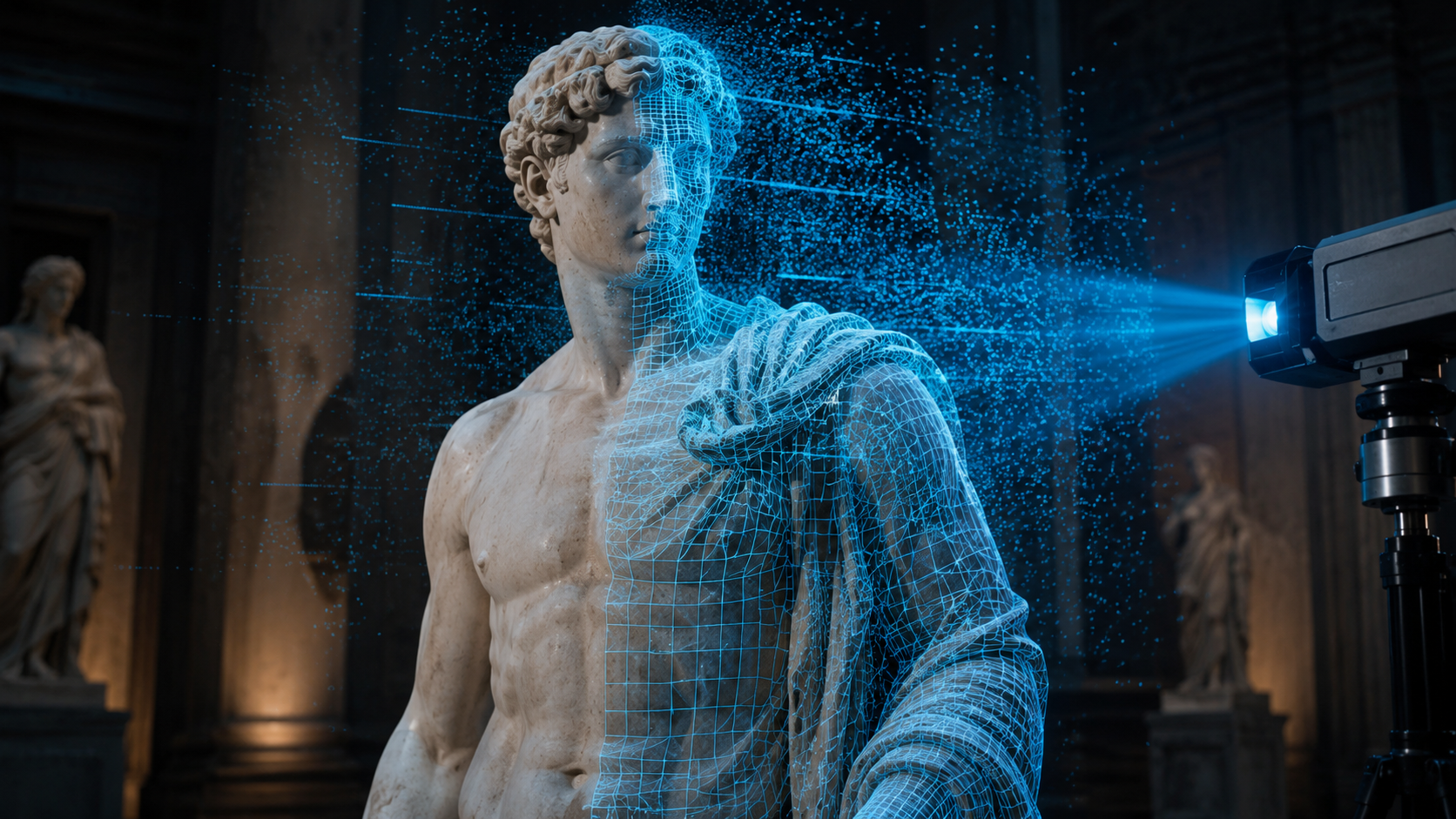
🔍 Technology Note Recent hybrid approaches combining LiDAR, photogrammetry, and structured light scanning achieve 15% improvement in geometric accuracy and 20% improvement in texture fidelity compared to single-technology methods (LiPhoScan model, published 2025). These multi-sensor workflows are becoming standard practice for high-value heritage documentation projects.
Part 6: Common Questions on Digital Sculpture Technology
Q: What is digital sculpture and how does it differ from traditional sculpture?
Digital sculpture uses 3D software, AI generation, and digital fabrication tools to create sculptural works, whereas traditional sculpture relies on direct manipulation of physical materials like clay, stone, wood, or metal. The key difference lies in workflow reversibility: digital sculptors can undo any action, branch iterations, and output to multiple media from a single digital master. Traditional sculpture requires material removal (carving) or additive work (modeling) that is physically irreversible. Digital sculpture also eliminates material costs during the design phase, enabling unlimited iteration before committing to fabrication.
Q: What software do professional digital sculptors use?
The industry standard is ZBrush, which handles up to 10 billion polygons and offers over 200 specialized brushes for organic detail work. Blender is the dominant free alternative, providing a complete pipeline including sculpting, retopology, UV mapping, and rendering. Many professionals use both: Blender for base mesh creation and hard-surface modeling, ZBrush for high-detail sculpting. For AI-assisted base mesh generation, Neural4D’s Image to 3D feature produces watertight geometry from a single photo that can be refined in any sculpting package. Nomad Sculpt has also gained traction on iPad for mobile sculpting with ZBrush-level brush behavior.
Q: Can AI create original sculpture designs without human input?
Current AI systems can generate novel sculptural forms from text prompts or reference images, but the output requires human curation and refinement to reach exhibition quality. AI excels at rapid concept exploration and base mesh generation, producing forms that are aesthetically novel and structurally coherent. However, sculptural intent, material knowledge, and cultural context remain human domains. The most effective practice is collaborative: AI generates candidates, the artist selects and refines. Autonomous AI sculpture creation without human oversight remains a research goal rather than a production reality. Systems like MetaSculptor can produce complete small-scale sculptures in a few hours, but these operate within defined aesthetic parameters set by a human director.
Q: How long does it take to 3D print a sculpture?
Print time depends on four variables: size, layer resolution, material, and printer type. A small figurine (10 cm tall) at standard 0.1 mm layer height on an FDM printer takes 4 to 10 hours. The same model in resin at 0.025 mm layer height takes 6 to 12 hours. A life-size bust at 0.2 mm layer height can require 60 to 120 hours of continuous printing. Large sculptures are typically printed in segmented parts, each taking 12 to 24 hours, with assembly and post-processing adding additional days. AI generation of the digital model, by contrast, takes 2 to 5 minutes for the base mesh and is unrelated to fabrication time, the bottleneck in digital sculpture production has shifted from design to physical fabrication.
Q: How accurate is 3D scanning for preserving cultural heritage sculptures?
Professional 3D scanning achieves sub-millimeter accuracy for sculpture documentation. Structured light scanners capture surface detail at 0.05 mm resolution. Photogrammetry with controlled camera arrays produces geometric error rates under 3% for objects up to several meters in size. Hybrid workflows combining LiDAR, photogrammetry, and structured light reach 0.0853 mm root-mean-square error with algorithm run times as low as 18 seconds per scan. These accuracy levels are sufficient for academic research, digital archiving, virtual restoration planning, and even CNC reproduction of damaged originals. For the Dazu Rock Carvings project, photogrammetric error rates were maintained below 3% despite the irregular surfaces and extreme scale of cliff-face carvings.
Q: Is digital sculpture cheaper than traditional sculpting methods?
The cost comparison depends on the production phase. Digital sculpture eliminates material costs during the design phase, where no clay, stone, or metal is consumed until the artist commits to fabrication. Software costs vary: Blender is free, ZBrush costs $399 per year, and AI generation services like Neural4D offer free tiers for evaluation. For small studios and independent artists, the digital pipeline is significantly cheaper for prototyping and iteration. At the fabrication stage, 3D printing materials are comparable to traditional materials for small pieces (under $50 for a resin figurine). For large-scale or bronze sculpture, 3D printing the positive for lost-wax casting is often cheaper than traditional clay-and-plaster methods. However, the equipment investment for high-resolution 3D printing and professional scanning remains substantial, with approximately 70% of small studios unable to afford industrial-grade hardware.
Conclusion: The Digital Future of Sculpture
The four pillars of digital sculpture technology (sculpting software, AI generation, 3D printing, and 3D scanning) have collectively transformed sculpture from a purely manual craft into a hybrid discipline where digital and physical methods reinforce each other. The evidence is clear in the numbers: a 50% reduction in effort for form refinement, 88% fewer fabrication defects through parametric regulation, and a market projection of 500 billion RMB in China alone by 2030.
Digital sculpture is not replacing traditional technique. It is expanding what sculpture can be, making the discipline faster to iterate, cheaper to prototype, more precise to fabricate, and more accessible to a broader range of practitioners. For artists and creators ready to integrate these tools into their workflow, the entry point has never been lower.
Create Your First Digital Sculpture
Neural4D converts photos and text into watertight 3D meshes that import directly into ZBrush, Blender, or your 3D printing slicer. Start with free weekly credits.
50 free Power credits weekly. No credit card required.