GPT-6 Astra 3D Modeling in Blender: What It Changes for AI 3D Content
Quick Summary
- GPT-6 Astra 3D modeling runs as an agent inside Blender, writing real Blender Python code, rendering intermediate frames, and revising the scene until it matches the brief.
- OpenAI reports BenchCAD 95.9% for CAD reconstruction and OSWorld 2.0 at 72.6% for computer use, up from 83.3% and 65.7% for its predecessor GPT-5.6 Sol.
- Agentic DCC control and native AI 3D generation are two roads to the same asset: one drives Blender, the other emits a finished mesh from a prompt or a photo.
- GPT-6 Astra turns 3D work from a one-shot generation into a supervised agent run, with real costs in time, tokens, and oversight.
- Neural4D is native AI 3D generation: a text prompt or a photo becomes a clean, watertight base mesh in about 90 seconds, with PBR textures in the same pass at two minutes or more, ready for further editing in Blender or Unreal Engine.
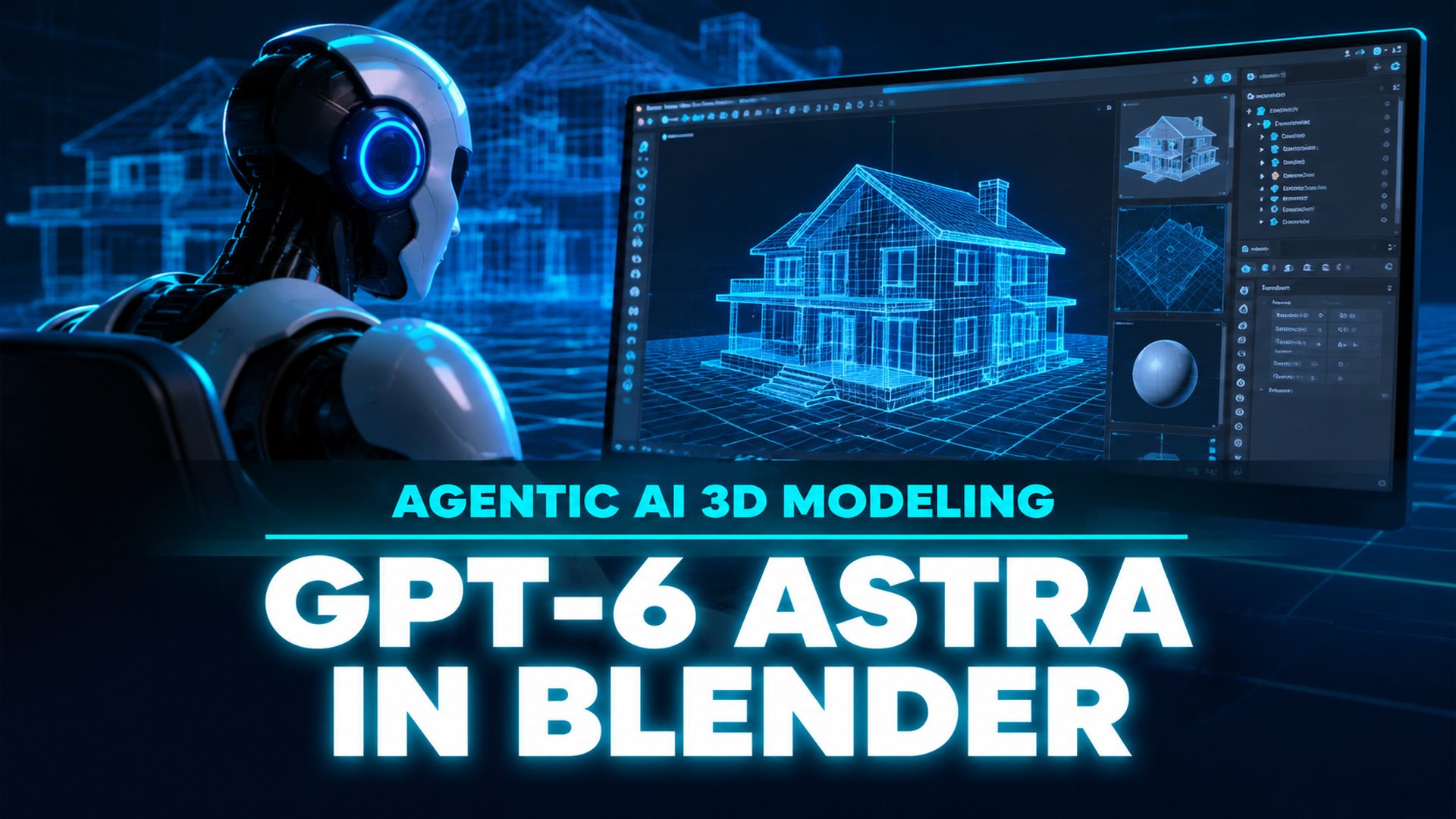
GPT-6 Astra 3D modeling in Blender is not another image to 3D diffusion model. It is an agent that operates the Blender application itself: it plans a scene, writes real Blender Python, renders frames, and edits the result until the geometry matches the brief. This article separates what the launch actually demonstrated from what it did not, then compares agentic Blender control with native AI 3D generation for production 3D content.
Contents
- How GPT-6 Astra 3D Modeling in Blender Works
- Agentic Blender vs Native AI 3D Generation: Two Roads to the Same Asset
- What Still Limits an AI Agent Operating Blender
- Where Neural4D Fits in an Agent-Driven 3D WorkflowHOT
- What the GPT-6 Astra Moment Means for 3D Teams
- Common Questions on GPT-6 Astra 3D Modeling and AI Agents
- Building a 3D Pipeline Around Both Roads
How GPT-6 Astra 3D Modeling in Blender Works
OpenAI released GPT-6 Astra on September 3, 2026. Its most watched 3D demonstrations were not still images of models. They were long agent runs inside Blender and Unreal Engine. Astra is a computer-use model first: it reads application state, plans a sequence of steps, and executes through the same interfaces a person uses. When the target is a digital content creation tool, that execution becomes real scene edits rather than a rendered mock-up.
The technical break from earlier generative 3D is that the model does not guess a mesh in a single pass. Classic image to 3D systems infer geometry from a prompt or reference and return one fixed result. Astra builds geometry programmatically. It checks reference material, writes Blender Python to create objects, modifiers, materials, and cameras, renders frames to inspect the outcome, then revises its own script wherever the render diverges from the brief. Because the work happens inside Blender’s data model, the deliverable stays a native, editable scene rather than a baked mesh.
The benchmark numbers line up with that design. On BenchCAD, which reconstructs 3D shapes from CAD code, Astra scores 95.9%, up from 83.3% for GPT-5.6 Sol. On OSWorld 2.0, which measures how well a model operates a computer, it reaches 72.6% against 65.7% for the previous model, completing tasks about 47% faster, according to coverage of the launch’s agent benchmark results. Those gains in CAD reconstruction and tool operation are the two capabilities that make the Blender demonstrations possible.
From a single image to an editable production scene
In the launch demonstration, Astra built a house in Blender and exported the result into a walkable Unreal Engine 5 environment with geometry, materials, and lighting intact. The meaningful part is not that the walls look right. It is that the output is a native scene graph the artist can keep editing, the same deliverable a human modeler would hand over. For teams that already move assets between tools, the export step is familiar; importing 3D models into Unreal Engine 5 well is what separates a usable level from a broken one.
The self-correction loop shows at its largest scale in the reconstruction of San Francisco’s Palace of Fine Arts. Astra worked overnight, consulted archival blueprints and photographs, wrote Blender Python to rebuild the facade, and used its own renders to check proportions before moving on. That is continuous quality control instead of one lucky pass, and it explains why the model is strongest on geometric, architectural, and CAD-style tasks where correctness can be checked against a source.
Agentic Blender vs Native AI 3D Generation: Two Roads to the Same Asset
An agent that operates Blender and a native AI 3D generator both answer “make me a 3D model,” but they answer in different places. A native generator runs its own geometry pipeline and returns a finished mesh. GPT-6 Astra opens Blender and operates it. Observers have pointed out that the model’s documented input and output are text and images, and that the “3D modeling” in the launch film is an agent writing Blender scripts and driving the interface rather than emitting native 3D output. That detail defines the second road: the agent is a driver of existing tools, not a geometry engine.
Which route fits depends on what “usable” means for the task. The table below compares the two AI routes plus the traditional baseline, with a native generator such as Neural4D’s AI image to 3D generation as the reference point.
| Route | How the geometry gets built | Time to a first asset | What you keep | Best fit today |
|---|---|---|---|---|
| Neural4D (native AI 3D generation) | Direct3D-S2 emits a clean mesh from a prompt or photo; PBR textures in the same pass | About 90 seconds for a base mesh; 2 minutes or more with full textures | Watertight geometry plus materials, exported as .fbx, .obj, or .glb | High volume props, products, printable parts, engine-ready assets delivered fast |
| GPT-6 Astra operating Blender or Unreal Engine | Writes Blender Python, self-checks rendered frames, edits the native scene | Minutes to hours per task, plus token cost per iteration | An editable scene inside the existing DCC file | Building or revising a deep scene where a native file must be edited in place |
| Manual Blender (human DCC work) | Modeling, retopology, UV and material work by hand | Days for complex assets | Full art control over the scene | High-end art direction where taste and judgment are the product |
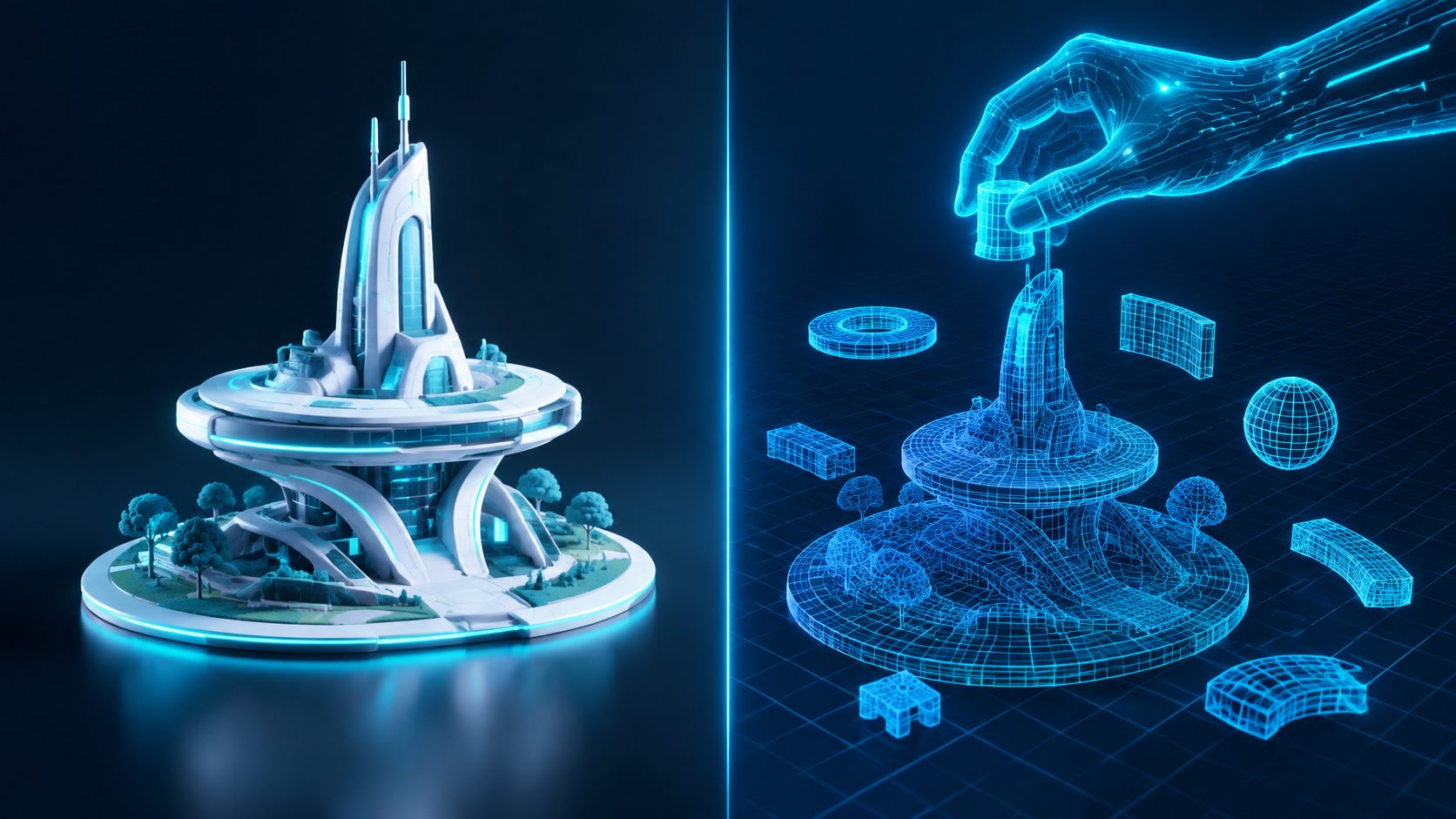
For a finished asset quickly, a prop, a product, or a printable part, native generation is faster by orders of magnitude. For constructing and editing a deep scene inside an existing DCC, an agent that can read and change Blender state is structurally closer to the job. Today that second path is slow and supervised, so the practical answer is not either or. It is a pipeline: generate clean base assets natively, then use an agent or a human to place, light, and refine them in the scene.
What Still Limits an AI Agent Operating Blender
Treat the launch demos as a ceiling, not a floor. OpenAI did not publish a standardized Blender benchmark, a repeated-attempt success rate, or a controlled comparison, and analysis from 3D artist Stefan Vaskevich makes the same point: the demonstrations do not establish performance across unfamiliar plug-ins, large production files, or differently organized studio scenes.
Time and tokens add up
An agent session runs on clock time and output tokens, and a self-correcting run is long by nature. The reconstruction of the Palace of Fine Arts was, literally, an overnight run. Compare that with a single native generation call. The cost structure reinforces the gap: GPT-6 Astra is priced at $10 per million input tokens and $50 per million output tokens. A task that writes and re-runs Blender Python dozens of times, rendering check frames between edits, consumes millions of output tokens. Each self-correction loop adds more, so open-ended sessions climb in cost while a well-scoped prompt does not.
What production teams should weigh today
- ❌ No standardized Blender benchmark or published success rate yet
- ❌ Reliability on large production files and unusual plug-ins is unproven
- ❌ Long sessions cost real money in output tokens and wall-clock time
- ✅ Strong on geometric, architectural, and CAD-style tasks with a checkable source
- ✅ The result is a native, editable scene when it works
Autonomy is supervised by design
OpenAI rates GPT-6 Astra its first model at the “Critical” cybersecurity tier, with a perfect ExploitBench score in testing, according to security coverage of the Critical rating. The shipped version is deliberately constrained: it refuses proof-of-concept exploit requests, enterprise access is off by default, and a monitoring layer can slow, pause, or stop a task. The practical consequence for 3D teams is that fully autonomous agent runs are not the product. Astra is designed to be watched, which is another reason supervised pilot projects fit the current reality better than hands-off pipelines.
There is also no in-app generator for an agent to call. Blender ships no first-party generative AI, so an agent operates the application through its Python API and interface automation. That integration and its failure handling remain the team’s responsibility, and early testers report strong results on regular, geometric objects with weaker performance on organic forms. The routine work is commoditizing faster than the judgment work, and the judgment still belongs to people.
Where Neural4D Fits in an Agent-Driven 3D Workflow
Every agent demonstration starts from a source: an image, a sketch, or a base mesh the agent can place into a scene. An agent edits existing geometry. It does not conjure clean production assets from nothing in seconds, and that boundary is exactly where native generation fits. Neural4D text to 3D and image to 3D convert a prompt or a photo into clean, watertight geometry with PBR materials in the same pass: about 90 seconds for an untextured base mesh, two minutes or more when full textures are included. Because the output is watertight and export ready in .fbx, .obj, or .glb, the asset drops into Blender or Unreal Engine without a cleanup pass.
This short walkthrough shows the handoff in practice: Astra generates a character image, then Neural4D turns that image into a high-detail 3D model without switching tools.
Clean base geometry is the quiet multiplier here. When the starting mesh is already manifold and properly formed, downstream work shrinks whether the editor is a human or an agent, and cleaner AI 3D models need less Blender cleanup. Neural4D-2o can apply conversational edits to models produced through Neural4D’s own pipeline, and any of those outputs can be exported for deeper scene work in a DCC alongside an AI 3D agent.
One boundary stays firm. Neural4D generates its own models; it does not import, repair, or retopologize geometry produced by third-party tools, including an agent operating Blender. The efficient division of labor is to generate cleaner output from the start rather than to fix someone else’s mesh later. Native generation supplies the finished base asset fast, and the agent contributes the deep scene edits that native generation is not built to do.
Turn a prompt into a production ready 3D model in minutes
Neural4D image to 3D and text to 3D emit clean, watertight, textured assets you can drop straight into Blender or Unreal Engine.
Free users get 50 Power credits every week. No credit card required.
What the GPT-6 Astra Moment Means for 3D Teams
The honest read from working artists is not that modeling is dead. It is that the value inside the job is moving. Vaskevich frames the shift as a transfer from manual execution toward directing systems, assembling outputs, and controlling quality: routine modeling, UV, and texturing work gets cheaper to automate, while the artist’s value moves to creative decisions and to bringing an incomplete machine result across the finish line. That is why he has been direct about the tradeoff: once an agent reliably does a task that needed trained hands, buyers expect faster delivery at a lower price.
For teams, the move is to design workflows that assume machines produce most of the volume and people control the quality gates:
- Use native generation for asset volume. An image to 3D or text to 3D pass returns finished base assets without occupying an agent, which is the pattern behind automating 3D generation workflows with AI agents.
- Keep agent runs on isolated prototypes. Let an agent prove itself on scratch files before it touches shared production scenes.
- Keep a human QC gate. Review topology, materials, file hygiene, and whether the output actually matches the brief.
- Run a rights and security review before an agent gets credentials and broad tool access inside the studio.
- Track the AI agent for 3D modeling category rather than one launch. The durable shift is that production ready AI 3D assets will be reviewed and finished rather than hand built.
Game production is already showing the pattern. In an OpenAI case study, Playco reported roughly 50% fewer manual corrections while prototyping games: from a single grey box foundation, the team produced three distinct themed prototypes, according to coverage of the Playco case study. The capability is real and it is being adopted, but adoption looks like supervised acceleration, not replacement.
Common Questions on GPT-6 Astra 3D Modeling and AI Agents
Yes, at least the fundamentals. Astra drives Blender through scripts and menus, but you still define the brief, judge the intermediate renders, spot a broken modifier stack, and finish the cases the agent leaves half done. Studios hiring for modeling roles are increasingly hiring for review and direction. Learn Blender as the language you use to brief and verify an agent, not only as software you operate by hand.
Not for the same job. A native generator answers “produce a clean textured asset from this prompt or photo” in a single call. Astra answers “edit this scene inside Blender” by driving the application over minutes to hours and thousands of tokens. The two solve different bottlenecks. When you need one finished prop quickly, a native generator wins. When you need a deep edit inside an existing scene, an agent is structurally closer, and a hybrid pipeline uses both.
Pricing is $10 per million input tokens and $50 per million output tokens. A session that writes and re-runs Blender Python many times, rendering check frames between edits, can pass through millions of output tokens, so a long task can reach tens of dollars on top of a ChatGPT or API subscription. Cost scales with the number of self-correction loops, which is why short, well-scoped tasks are dramatically cheaper than open-ended exploration.
Not for most pipelines yet. The launch demos were curated, and no standardized Blender benchmark or published success rate exists. Early testers report strong results on regular, geometric objects and weaker results on organic forms, with printability questions such as wall thickness and supports still needing human judgment. Topology quality and reliability on large production files with unfamiliar plug-ins remain open questions.
Yes. The launch film shows the full chain: a yellow circle becomes a rocket, Astra models it in Blender, exports an STL file, and sends it to a Bambu Lab P1S printer for a physical print. For a reliable print you still need a watertight, manifold mesh, and testers note the agent can produce geometry that needs checking for wall thickness and supports before slicing. Native generators avoid that risk from the start because they output watertight geometry.
Building a 3D Pipeline Around Both Roads
The useful frame is not a winner. Native generation and agentic tool control will both improve, and they reward different bottlenecks. GPT-6 Astra 3D modeling is best understood as a new editing layer on top of a fast supply of clean base assets: the agent shines when a native file already exists to be placed, lit, and refined. A team that treats the two as a pipeline, generating clean watertight assets natively and reserving agents for supervised scene work, gets speed and depth without betting the whole production on either model.
Native generation for speed. Agent editing for depth.
Generate clean base assets in minutes, then refine the scene in your DCC by hand or with an agent.
Paid plans include full commercial rights on your assets.