3D Digital Human Sports Broadcasting: What the 2026 World Cup Pipeline Means for Creators
The 2026 World Cup deployed full-body 3D digital human avatars in live match broadcast for the first time, replacing traditional 2D offside lines with real-time 3D digital human sports broadcasting. This is not a laboratory prototype. It is a production pipeline running across 104 matches in 16 stadiums across three countries, processing over 150 million tracking data points per match. For anyone working in 3D content creation, the technical choices made here reveal where the industry is heading.
Contents
- Part 1: The 3D Digital Human Breakthrough at the 2026 World Cup
- Part 2: How the Real-Time 3D Pipeline Actually Works
- Part 3: What This Means for 3D Content Creators
- Part 4: Where Real-Time 3D Technology Is Headed Next
- Part 5: Where Neural4D Fits in the New 3D Workflow
- Part 6: Common Questions on 3D Digital Human Technology in Sports
- Start Creating 3D Digital Humans Today
Part 1: The 3D Digital Human Breakthrough at the 2026 World Cup
For years, sports broadcasts explained offside calls with the same visual: a static 2D line drawn across a frozen video frame. Fans in the stadium squinted at the jumbotron. Viewers at home watched a slow-motion replay with a yellow line that approximated, but never truly represented, the players’ actual body positions. The 2026 World Cup marks the first time 3D digital human sports broadcasting replaced that 2D approximation with full-body animated avatars.
Working with technology partner Lenovo, FIFA deployed a system that creates a personalized 3D digital human for every single player and uses those avatars to explain referee decisions in real time. The result is displayed as a full 3D animated replay, accurate to the position of each limb at the moment the ball was played.
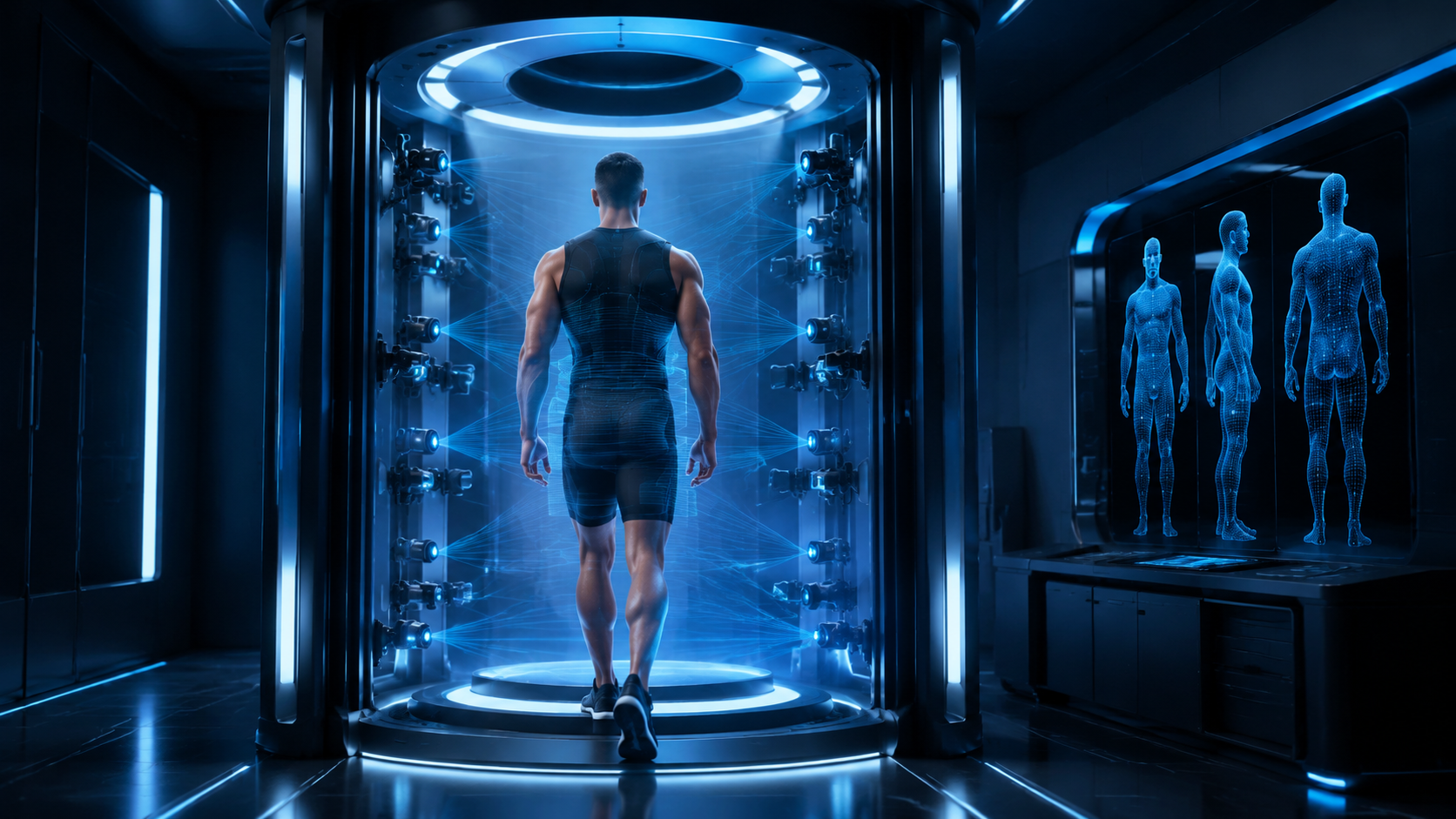
The scale is worth pausing on. 1,248 players from 48 teams were individually scanned. Each scan took roughly one second and captured body dimensions to within 0.5 cm tolerance including leg length, shoulder width, and torso contour. These scans feed into the Football AI Pro digital backbone, which FIFA and Lenovo unveiled at CES 2026 and tested during the 2025 FIFA Intercontinental Cup before deploying it at the World Cup. The official FIFA announcement described the avatars as enabling offside calls to be “displayed more realistically and in a more engaging way” compared to the previous generation of semi-automated offside technology.
Part 2: How the Real-Time 3D Pipeline Actually Works
The 3D digital human sports broadcasting pipeline breaks down into four stages, and each stage maps onto a familiar concept in 3D content creation.
Stage 1: Volumetric Capture (The Scan)
Each player enters a scanning pod at their team’s training camp. The system captures a full 3D volumetric profile in about one second. This is not a surface scan for visual fidelity. It is a precision measurement rig designed to produce mathematically accurate body dimensions that can withstand the scrutiny of offside rulings.
Stage 2: Real-Time Skeletal Tracking (The Mocap)
During the match, each stadium is equipped with optical tracking cameras installed in the roof. These cameras capture 29 skeletal data points per player at 50 frames per second. According to coverage by Sports Business Journal, each stadium uses 16 dedicated tracking cameras for this purpose. No mocap suits. No markers. The system tracks every player simultaneously, even during fast movements or when players are partially occluded.
Stage 3: 3D Mapping (The Rig)
The Football AI Pro digital backbone maps the 2D camera data onto each player’s personalized 3D avatar in real time. This is where the per-player scan data becomes critical. The system knows the exact proportions of each player, so it can infer limb positions from skeletal data alone without guessing at body geometry.
Stage 4: Automated 3D Animation Generation (The Render)
When the system detects a potential offside, it generates a full 3D animated replay automatically. The animation processes in roughly 30 seconds and is pushed to stadium screens and the international broadcast feed. The ball itself plays a role here. The Adidas Trionda match ball contains an IMU sensor chip recording data at 500 Hz, which pinpoints the exact moment the ball was played.

In total, the system processes over 150 million tracking data points per match. To put that in context, a typical AAA game character might use 150-300 bones for animation. The World Cup system tracks 29 nodes per player, but it does so for all 22 players simultaneously, in real time, across 16 stadiums, for 104 matches. That is an infrastructure commitment measured in 90+ petabytes of data handling.
Part 3: What This Means for 3D Content Creators
This is where 3D digital human sports broadcasting stops being a sports story and starts being a signal for everyone who works with 3D content. Three shifts matter.
Markerless Real-Time Mocap Is Production Ready
The World Cup proved that 3D digital human sports broadcasting can produce broadcast-quality skeletal animation without a single motion capture suit. Multi-view camera arrays combined with AI tracked 29 nodes per player across 22 simultaneous players in live match conditions. This is the same technology trajectory that companies like Rokoko, Move.ai, and Kinetix have been pushing. The difference is the scale of validation. When a system processes 150 million data points per match under live broadcast conditions, the reliability question is answered.
For indie 3D creators and small studios, the practical implication is direct. The cost of entry for motion capture has dropped another notch. If a stadium roof camera system can track 22 players simultaneously with 29 nodes at 50 fps, a well-lit room with three webcams can track one actor. The algorithmic core is commodity; the resolution and camera count scale with budget.
Automated 3D Narrative Animation Is Here
Offside calls are now automatically converted into 3D explainer animations. This is machine-generated 3D storytelling. The system ingests spatial data, makes a referee decision, and outputs a narrated 3D animation without human intervention in the animation pipeline. For creators, this signals that automated 3D narrative generation is leaving the lab and entering production tools.
Think about what that means for adjacent industries. Sports analysis content, news visualization, educational simulations, and data journalism all follow the same pattern: structured data in, 3D visual narrative out. The technical architecture that makes this possible at the World Cup will find its way into production tools within the next 12 to 24 months.
Precision Standards Are Rising
The 3D digital humans used in World Cup broadcasts are not judged by whether they look good. They are judged by whether they are accurate enough for offside rulings. The system flags offside positions as close as 10 cm, and the avatar body dimensions are certified to within 0.5 cm of the real player. As SportsPro reported, the 3D avatars were designed to enable “faster decisions and a clear understanding by everyone.”
The market expectation for digital human accuracy is moving from “looks right” to “physically exact.” That shift changes what counts as a production-ready 3D asset, and it raises the floor for creators who want their work taken seriously in professional pipelines. The arrival of 3D digital human sports broadcasting at the World Cup is a direct signal that sub-centimeter precision is now the baseline.

Part 4: Where Real-Time 3D Technology Is Headed Next
The infrastructure behind 3D digital human sports broadcasting is not a one-off technology showcase. FIFA and Lenovo signed a technology partnership covering both the 2026 men’s World Cup and the 2027 Women’s World Cup. The same digital infrastructure including the Football AI Pro system, the 3D avatar pipeline, and the digital twin stadium platforms will carry forward. The financial commitment behind this is measured in the hundreds of millions of dollars.
Several developments follow from this trajectory.
AI-powered broadcast production is scaling fast. NBC Sports and Peacock are already using AI-driven production systems for player tracking, face tagging, and automatic vertical video cropping for mobile viewing during the World Cup. The same Sports Video Group report notes that these workflows are being built for scale, not just pilot programs.
Digital twin infrastructure is becoming standard. Every stadium in the World Cup has a digital twin used for crowd monitoring, security, and operational management. The same principle whether it is a stadium or a factory floor applies to any physical environment that needs real-time 3D monitoring.
The rendering pipeline is moving to edge compute. VAR processing now happens on-site rather than in the cloud, reducing latency to actionable timeframes. For 3D creators, this confirms what game developers already know: real-time rendering at the edge is the default, not a niche optimization.
Here is the bottom line for 3D creators: The skills that used to be optional extras rigging, real-time rendering pipelines, procedural animation, digital human workflows are becoming core infrastructure. The World Cup pipeline proves that real-time 3D digital human technology can operate at industrial scale. The question is not whether this technology will reach your workflow. It is whether you start preparing for it now.
Part 5: Where Neural4D Fits in the New 3D Workflow
The World Cup pipeline is built on a massive infrastructure of stadium cameras, scanning pods, and custom AI systems. Most 3D creators do not have access to any of that hardware. But the same technological trends that made 3D digital human sports broadcasting possible are also reshaping the tools available to individual creators and small studios.
Neural4D was built for this shift. The core workflow upload a reference image, generate a production-ready 3D model, fine-tune with natural language, and export to standard formats directly maps onto the direction the industry is heading: less manual geometry work, more creative iteration.
Three specific capabilities align with the trends the World Cup demonstrated:
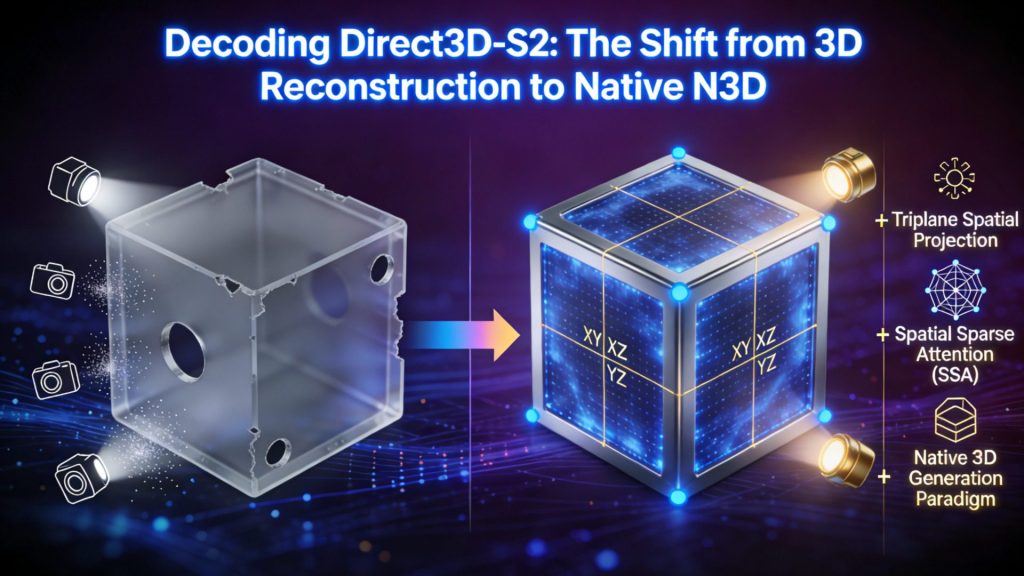
- Image to 3D generation: Upload a single photo and get a watertight 3D mesh with PBR textures. The Direct3D-S2 engine processes the full volume to ensure manifold geometry, which means the output is ready for game engines, web viewers, or 3D printing without manual cleanup. The same principle that lets the World Cup reconstruct a player’s full body from camera data applies here at the individual creator scale.
- Neural4D-2.5 conversational modeling: Fine-tune your 3D model using natural language instead of pushing vertices. If the proportions are off or a detail needs adjusting, describe what to change. This is exactly what the World Cup’s Football AI Pro does at a different scale: using AI to interpret human intent and generate 3D output.
- Clean topology and PBR material output: Every model exports with properly mapped Normal, Roughness, and Metallic maps. The output drops straight into Unity, Unreal, or any standard renderer. No intermediate format conversion. The World Cup pipeline does the same thing for broadcast: the 3D animation goes directly from the AI system to the stadium screen without a human animator in the loop.
To see how Neural4D approaches 3D generation from a single image, visit the Image to 3D feature page or explore the Text to 3D capabilities for generating models from written descriptions.
Generate 3D Digital Humans From a Single Image
Watertight meshes. PBR textures. Engine-ready exports. No manual retopo needed.
Start Creating 3D Digital Humans
50 free credits per week. No credit card required.
Part 6: Common Questions on 3D Digital Human Technology in Sports
Q: How does the 3D avatar offside technology work at the 2026 World Cup?
A: Each player is scanned before the tournament to create a millimeter-accurate 3D digital twin. During matches, 16 optical cameras per stadium track 29 skeletal nodes per player at 50 fps. When a potential offside occurs, the Football AI Pro system cross-references the ball contact moment (captured at 500 Hz by a sensor in the match ball) with each player’s 3D avatar position. The 3D digital human sports broadcasting pipeline then generates a full 3D animated replay showing exactly which body parts were offside and at which frame.
Q: Do players need to wear motion capture suits?
A: No. The entire system is markerless. Players walk through a scanning pod once before the tournament for body dimension capture. During matches, optical cameras track their movements without any wearable hardware. The AI maps the camera data onto each player’s personalized 3D avatar using the pre-scanned body proportions to infer accurate limb positions. This is the same markerless approach that consumer-grade mocap tools are adopting, but at a much higher camera count and precision tolerance.
Q: Can 3D creators use similar technology without access to stadium camera systems?
A: Yes, at a different scale. The algorithmic core of markerless skeletal tracking is widely available through tools like Move.ai, Rokoko Vision, and Kinetix. While the World Cup uses 16 dedicated cameras per stadium, a single webcam or phone camera can capture basic skeletal data for animation. The tradeoff is precision. The World Cup system operates at 50 fps with 0.5 cm tolerance across 22 simultaneous players. A single-camera setup will have lower accuracy and occlusion handling, but the fundamental technology is the same.
Q: How accurate are the 3D digital humans used in World Cup broadcasts?
A: The player scans capture body dimensions to within 0.5 cm tolerance. The tracking system can flag offside positions as close as 10 cm, a significant improvement from the 50 cm threshold in previous World Cup tournaments. Skeletal data is captured at 50 fps from 29 nodes per player. The system processes over 150 million data points per match. Accuracy degrades in edge cases such as players clustered together or on the ground, where occlusion makes limb tracking unreliable. For these situations, the video assistant referee still makes the final call.
Q: What happens when the 3D tracking system cannot determine a player’s position accurately?
A: The system is designed to flag uncertainty rather than guess. When players are clustered together, on the ground, or partially obscured, the tracking confidence drops below the threshold required for automated offside detection. In those cases, the system does not generate an automatic alert. The video assistant referee team relies on standard camera angles and manual review instead. This fail-safe behavior is an important design principle for any real-time 3D tracking system: knowing when not to trust the output is as important as generating it.
Q: Is this technology limited to sports broadcasting, or will it spread to other 3D applications?
A: The core technologies markerless real-time mocap, automated 3D animation generation, and personalized digital human creation are already moving beyond sports. Game studios are testing similar multi-camera setups for in-engine character animation. Virtual production pipelines are adopting real-time skeletal tracking for live on-set previz. E-commerce platforms are exploring automated 3D product visualization. The World Cup deployment proves that 3D digital human sports broadcasting works at a scale and reliability level required for live global broadcast, accelerating adoption across adjacent industries.
Start Creating 3D Digital Humans Today
The 2026 World Cup proved that 3D digital human sports broadcasting is not a future concept. It is a live production pipeline processing over 150 million data points per match across 16 stadiums. For 3D creators, the message is direct: markerless mocap, automated 3D animation, and sub-centimeter digital human accuracy are leaving the lab and entering real-world production workflows.
The tools for individual creators follow the same trajectory. Neural4D gives you the capability to generate production-ready 3D models from a single image, refine them with natural language, and export them directly into game engines, web viewers, or 3D printing slicers. The same trends that power 3D digital human sports broadcasting at the World Cup are available at your desk.
Your First 3D Digital Human Is One Click Away
Upload an image. Get a watertight mesh with PBR textures. No experience required.
Free to start. 50 Power credits weekly. Upgrade anytime.