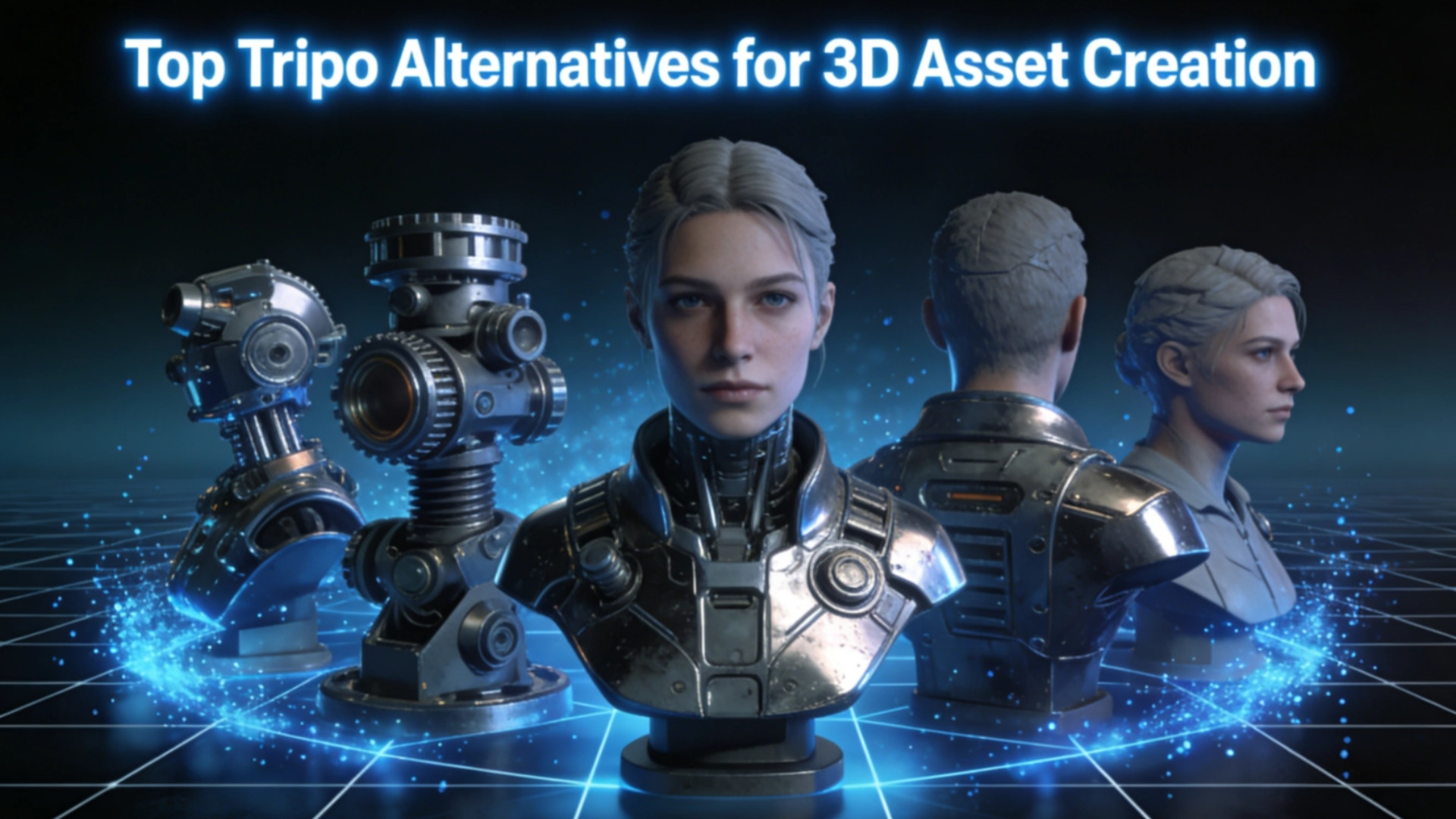
Top 5 Tripo Alternatives for Professional 3D Asset Creation
As the global 3D modeling market climbs toward a projected $17.68 billion valuation in 2026, the industry is shifting away from basic “experimental” generation toward production-ready assets. While Tripo has successfully democratized 3D creation with over 3 million users, professional studios often hit a “quality ceiling” regarding mesh topology and geometric resolution.
For creators requiring high-fidelity outputs that integrate seamlessly into AAA game engines or industrial simulations, finding a robust Tripo alternative is no longer optional – it’s a workflow necessity. Below is a detailed breakdown of the top professional alternatives available this year.
Table of Contents
The Best Professional Tripo Alternatives of 2026
To help you choose the right tool for your pipeline, we have evaluated the leading platforms based on their technical architecture, pricing transparency, and specific use cases.
1. Neural4D: The High-Resolution “Native” Leader
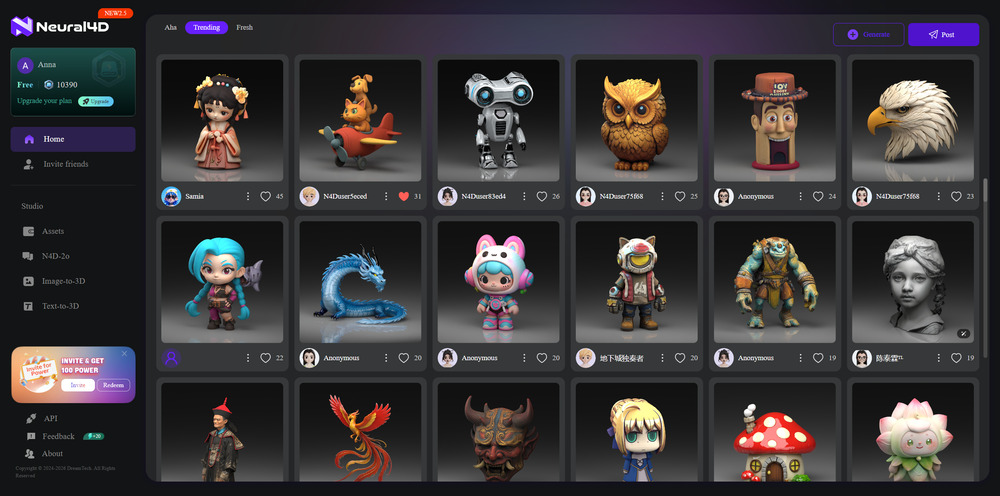
Neural4D represents the shift from 2D-to-3D reconstruction to the N3D Paradigm, a method that natively generates 3D structures in latent space. This eliminates the “hallucinations” often found in basic reconstruction models. It is a professional-grade platform powered by the Direct3D-S2 architecture, capable of producing watertight meshes with unmatched geometric detail.
💰 Pricing: Freemium. Free users receive 600 power (credits) every month. Paid plans start at $6.9/month for expanded parallel tasks and commercial rights.
👍 Strengths: Supports 1024³ resolution, a feat typically requiring massive GPU clusters but made possible here via Spatial Sparse Attention (SSA). This tech provides a 3.9× speedup in generation while maintaining industrial-grade mesh integrity.
👎 Weaknesses: The high resolution means export files are significantly larger, requiring more storage and bandwidth.
✅ Best For: AAA game development, architectural visualization, and industrial digital twins where “watertight” geometry is mandatory.
User experience: Very easy to use. The interface is optimized for professionals who need high-quality results without deep manual modeling knowledge.
2. 3D AI Studio: The Versatile Multi-Model Hub
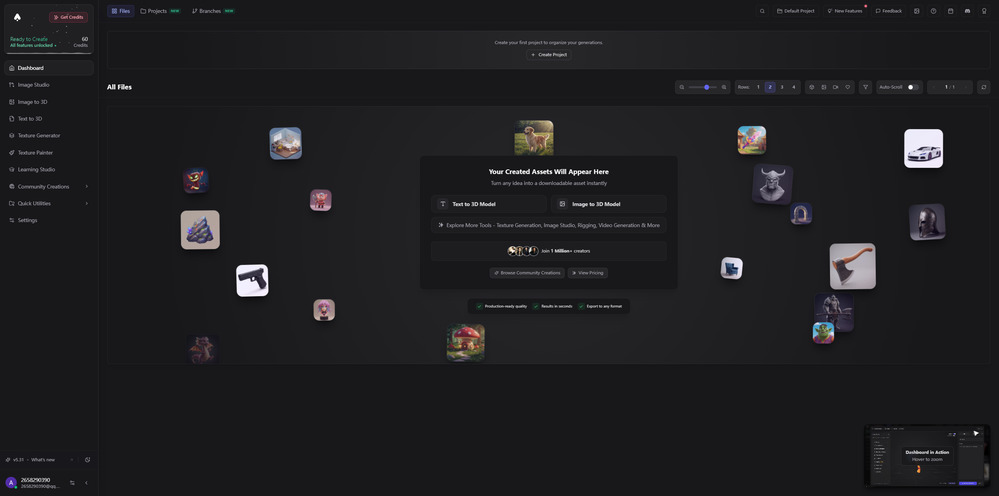
3D AI Studio is a comprehensive hub that allows users to toggle between different generation engines depending on the desired artistic style. If variety is your priority, 3D AI Studio is your flexible Tripo AI alternative.
💰 Pricing: $14/month for 1,000 credits, or a popular $29/month access deal for individual creators.
👍 Strengths: Excellent “Text-to-Texture” capabilities; allows for rapid testing across different AI architectures within a single dashboard.
👎 Weaknesses: Because it aggregates third-party models, output consistency and topological quality can vary from one model to the next.
✅ Best For: Creative freelancers and hobbyists who need a Tripo 3D AI alternative to explore various aesthetic styles at a low cost.
User experience: You need to choose many options for generating a 3D model. Remember to choose your favorite engine first.
Read also: Best Free Alternatives to Hitem3D 2026
3. Sloyd: The Parametric Prop Specialist
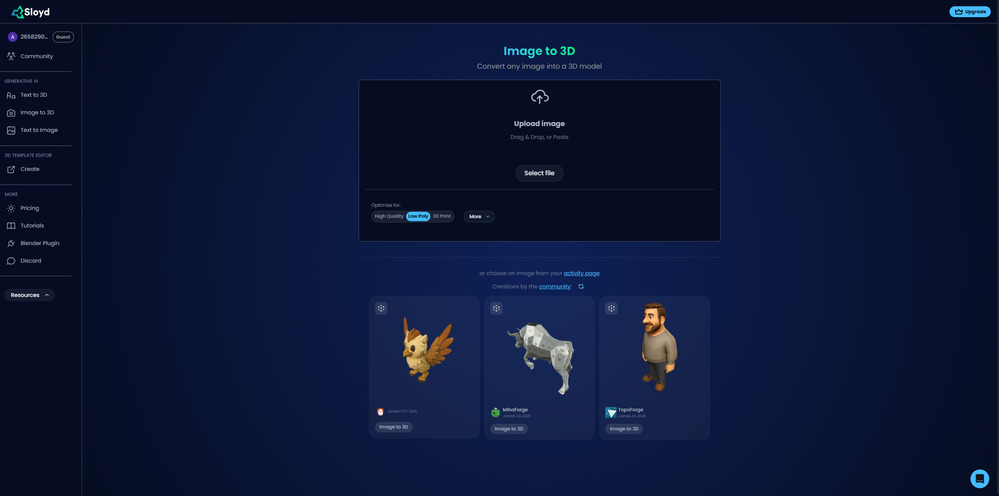
Sloyd takes a different approach by combining AI with parametric templates, ensuring that the generated models follow strict geometric rules. Is is a specialized tool that excels in hard-surface modeling by using adjustable sliders to refine AI-generated prompts.
💰 Pricing: Free for experiencing limited functions; Pro tier costs $25/month for unlimited generations.
👍 Strengths: Produces the cleanest, most “human-like” quad topology; offers real-time editing of generated parts (e.g., blade length, chair leg width).
👎 Weaknesses: Limited to its template library; struggles with organic shapes or highly unique, irregular character designs.
✅ Best For: Game level designers who need thousands of consistent, optimized background props and weapons.
User experience: Easy to use and simple interface. Few and normal functions for beginners. Individual creators should use Neural4D or Tripo.
4. Meshy: The Rapid Texture & Preview Engine
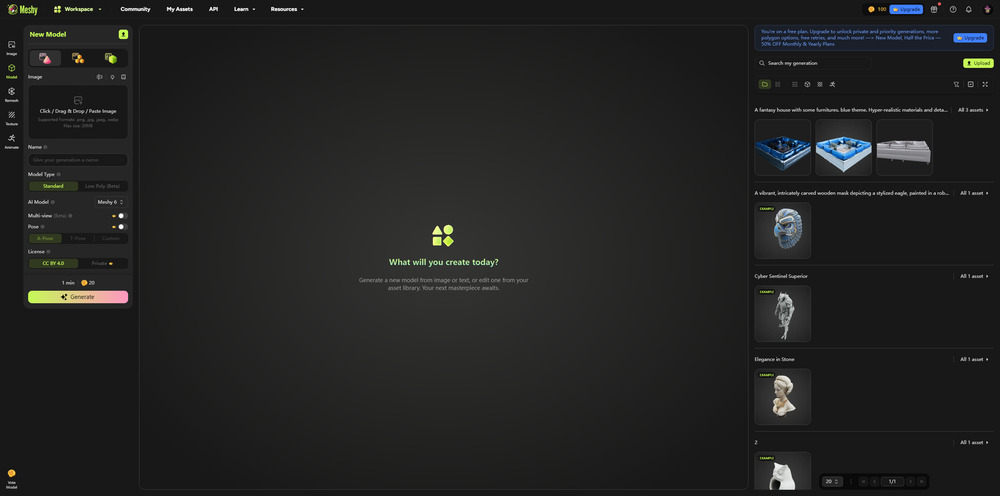
Meshy has remained a staple in the Tripo 3D alternative space by focusing on the speed-to-texture ratio, making it ideal for the early ideation phases. It is a cloud-based generator known for its lightning-fast previews and impressive PBR material baking.
💰 Pricing: 100 free credits per month; Pro subscriptions at $20/month.
👍 Strengths: Best-in-class text-to-texture mapping; seamless integration with Blender via a dedicated plugin.
👎 Weaknesses: The underlying geometry is often less detailed than 1024³ native generators, sometimes resulting in softer edges.
✅ Best For: Indie developers and social media artists who prioritize rapid prototyping and high-quality textures over extreme geometric precision.
User experience: Colorful interface and rich features, but some functions are not free.
Read More: Best Meshy Alternative 2026: 7 Free Online AI 3D Tools
5. Rodin (Hyper3D): The Photorealistic Specialist
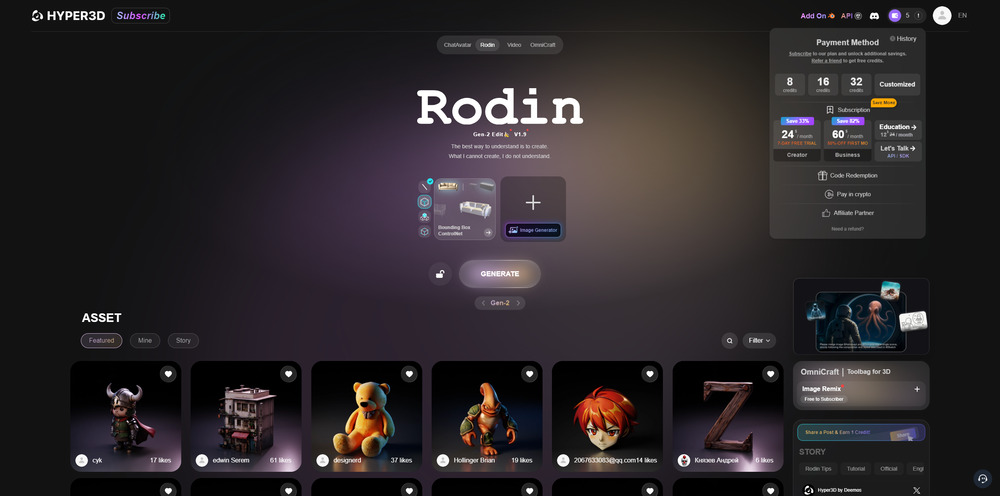
For those who need to convert 2D photos into “hero” assets with cinematic lighting, Rodin is a premium contender. It is focuse on high-fidelity surface reconstruction and material accuracy.
💰 Pricing: Free for limited functions. High-tier pricing (starting at $30/month for full production features).
👍 Strengths: Exceptional handling of metallic and translucent materials; high consistency with the original 2D reference image.
👎 Weaknesses: Slower generation times for high-res tasks; significantly higher cost per credit compared to other alternatives.
✅ Best For: E-commerce visualization and high-end marketing campaigns requiring photorealistic rendering.
User experience: Well. HYPER3D provides different kinds of functions in one interface. It is hard to choose your wanted features for use.
Why “Watertight” Geometry is the New Standard
Recent industry data shows that 58.72% of the 3D modeling market has migrated to cloud deployment in 2026. This shift has raised the bar for what a “good” model looks like. Professionals no longer accept the “triangle soup” meshes common in early 2024.
The N3D Paradigm utilized by Neural4D addresses this by ensuring every generated asset is “Simulation-Ready.” Because the model understands 3D space natively, the resulting FBX or OBJ files possess correct mass distribution and watertight surfaces – critical for physics-based simulations and 3D printing.
Read More: Convert Image to STL File: Expert AI 3D Generation Guide
FAQs about Tripo Alternatives
Q: Is there a Tripo AI free alternative with high credit limits?
A: Yes, Neural4D offers 600 free power per month to users, which is one of the most generous entry points in the professional market.
Q: Can these AI models be edited in Blender or Maya?
A: Yes. All the professional alternatives listed support FBX and OBJ exports.
Q: Which Tripo 3D alternative is best for 3D printing?
A: Neural4D is the preferred choice for 3D printing because its native generation architecture ensures “watertight” meshes (no holes or self-intersecting faces), which saves hours of manual repair in software like Meshmixer.
Q: How does SSA technology affect the quality of a Tripo 3D AI alternative?
A: Spatial Sparse Attention (SSA) allows a tool like Neural4D to focus computational power only on the active parts of a 3D volume. This allows it to reach 1024³ resolution without the massive hardware lag found in traditional volumetric modeling.
Conclusion: Choose the Right Tripo Alternative
Choosing a Tripo alternative in 2026 comes down to your production requirements. If you need a quick visual concept, Meshy is excellent. If you need vast libraries of props, Sloyd is your best bet. However, for those who require high-resolution, production-ready assets that can withstand industrial scrutiny, Neural4D stands at the forefront with its 600 free power entry point and 1024³ native architecture.