Best Meshy Alternative 2026: 7 Free Online AI 3D Tools Ranked & Reviewed
Editorial note: This article is written by the Neural4D team based on Q1 2026 internal testing and production pipeline experience. Neural4D is one of the tools reviewed. We have made an effort to present each tool’s genuine strengths and limitations, including our own.
Quick Summary
Meshy alternatives are AI 3D generation tools that offer different specializations in mesh topology, texture resolution, and pipeline compatibility.
- Neural4D and Tripo AI each address different output requirements: Neural4D focuses on watertight geometry while Tripo prioritizes generation speed.
- Rodin specializes in photorealism for hero assets and digital humans with high-resolution PBR maps.
- Hitem3D and Spline serve specialized pipelines: manufacturing readiness and web 3D respectively.
- CSM and Stable Fast 3D address multi-view consistency and open-source local deployment.
- Neural4D focuses on watertight geometry for production pipelines with its Direct3D-S2 engine.
Table of Contents
- · Part 1: 2026 Comparison Matrix
- · Part 2: Why Professionals are Switching: The Cleanup Debt Problem
- · Part 3: In-Depth Reviews of the 7 Best Meshy Alternatives
- , Neural4D: The Manufacturing & Furniture Leader
- , Tripo AI: Speed & Concepting Specialist
- , Rodin: Photorealism for Hero Assets
- , Spline: Interactive Web 3D Powerhouse
- , Hitem3D: Industrial & 3D Printing Pro
- , CSM: World-Model View Consistency
- , Stable Fast 3D: Open Source Privacy
- , 2026 Newcomers: TRELLIS 2 & Hunyuan3D
- · Part 4: FAQ , Common Questions
- · Part 5: Conclusion
In 2026, the 3D generation market has shifted from visual novelty to industrial utility. If you are searching for a Meshy AI free alternative with production-ready output, the options have expanded significantly in 2026. While Meshy remains a popular starting point, the demand for a professional Meshy alternative with superior topology and zero cleanup debt has skyrocketed. Whether you are building for Unreal Engine 5 or high-end 3D printing, picking the right engine is critical for a smooth production pipeline.
Part 1: 2026 Comparison Matrix
| Tool | Core Technology | Native Res | Best Case | Free Tier |
|---|---|---|---|---|
| Neural4D | Direct3D-S2 + SSA | 2048³ | Manufacturing & Furniture | Yes |
| Tripo AI | Smart Mesh P1.0 | High Visual | Rapid Concepts | Yes |
| Rodin | Neural Render | Ultra-High | Photorealism | Trial |
| Spline | Browser AI | Web Ready | Web UI/UX | Yes |
| Hitem3D | Sparc3D + Ultra3D | 1536³ | Industrial Printing | Yes |
| CSM | World Model | Consistency | Multi-View | Yes |
| Stable Fast 3D | Open Source | Mid-Poly | Local Power | Free |
| TRELLIS 2 | Structured Latent | High-Poly | Open-Source Production | Free |
| Hunyuan3D 2.0 | Dual-Stage PBR | High Visual | Native PBR Textures | Free |
In July 2026, Meshy introduced native 8K (8192×8192) texture generation powered by Multiview Diffusion. This update raises the texture resolution standard for AI 3D tools. The tools in this comparison approach output quality differently: Neural4D prioritizes watertight geometry at 2048×2048 resolution, while Hitem3D targets manufacturing readiness at 1536×1536. The right choice depends on whether texture resolution, mesh topology, or pipeline compatibility matters most for your specific project. For the stages that follow asset generation, from texturing to compositing, our roundup of the best VFX software covers the rest of the production pipeline.
Meshy has kept shipping since that texture update. Meshy 7 arrived on August 10, 2026, and Meshy 7.1 followed on September 10, 2026, adding an Ultra 4K mode that generates geometry at 4096³, twice the 2048³ native resolution Neural4D works at, with raw meshes of up to 80 million triangles before simplification. Two limits matter before you factor it into a decision: Ultra 4K accepts single-image input only, so multi-view workflows stay capped at Ultra 2K, and both Ultra modes plus any download require a paid subscription, even though 7.1 itself is open to all registered users. Higher voxel density also does not change edge flow, so the cleanup debt described in Part 2 remains. Our Meshy 7 release date and 7.1 breakdown covers the full timeline and benchmark numbers.
Compare 3D Generation Quality Yourself
Test Neural4D watertight geometry against other tools. Download your model and inspect the topology.
Free users get 50 credits per week. No credit card required.
Part 2: Why Professionals are Switching: The Cleanup Debt Problem
The most significant challenge for creators in 2026 is cleanup debt. Many legacy AI models produce geometry that looks good in a preview but breaks during rigging or animation. This shift has led users to seek a high-quality Meshy alternative that generates clean, quad-dominant structures immediately, reducing time-to-market for complex 3D projects.
📊 2026 Market Insight
In 2026, topology quality has overtaken generation speed as the defining benchmark for professional 3D pipelines. Studios and manufacturers are increasingly filtering tools not by visual output but by whether the mesh survives rigging, slicing, and physics simulation without manual repair.
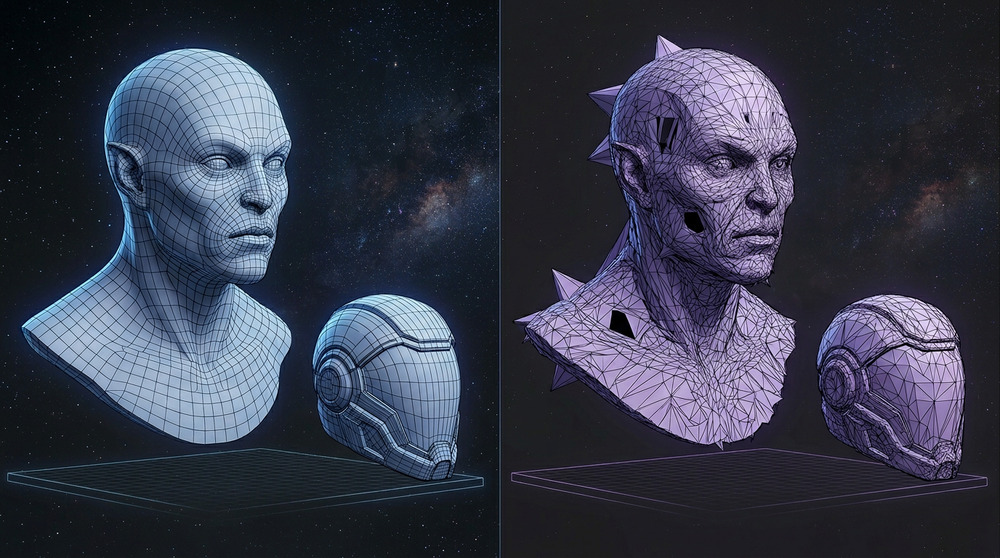
Left: Neural4D’s quad-dominant topology , clean edge flow, zero artifacts. Right: A typical AI mesh with triangulated faces, poles, and broken edge loops that require hours of manual retopology before production use.
See Neural4D generate a production-ready architectural model in seconds , with zero manual cleanup required before slicing.
Want to test the topology quality yourself? Browse Neural4D’s generated model library and download samples in .GLB, .FBX, or .OBJ format.
In June 2026, Meshy launched the 3D Agent (Beta), a conversational AI system for multi-step 3D creation. It supports brainstorming, batch generation, and style-consistent asset families within a single chat session. For users evaluating alternatives, the key question is whether their priority is an integrated conversational workflow or specific output characteristics such as mesh topology, texture resolution, or pipeline compatibility.
Part 3: In-Depth Reviews of the 7 Best Meshy Alternatives
Neural4D: The Professional Benchmark for Manufacturing & Furniture
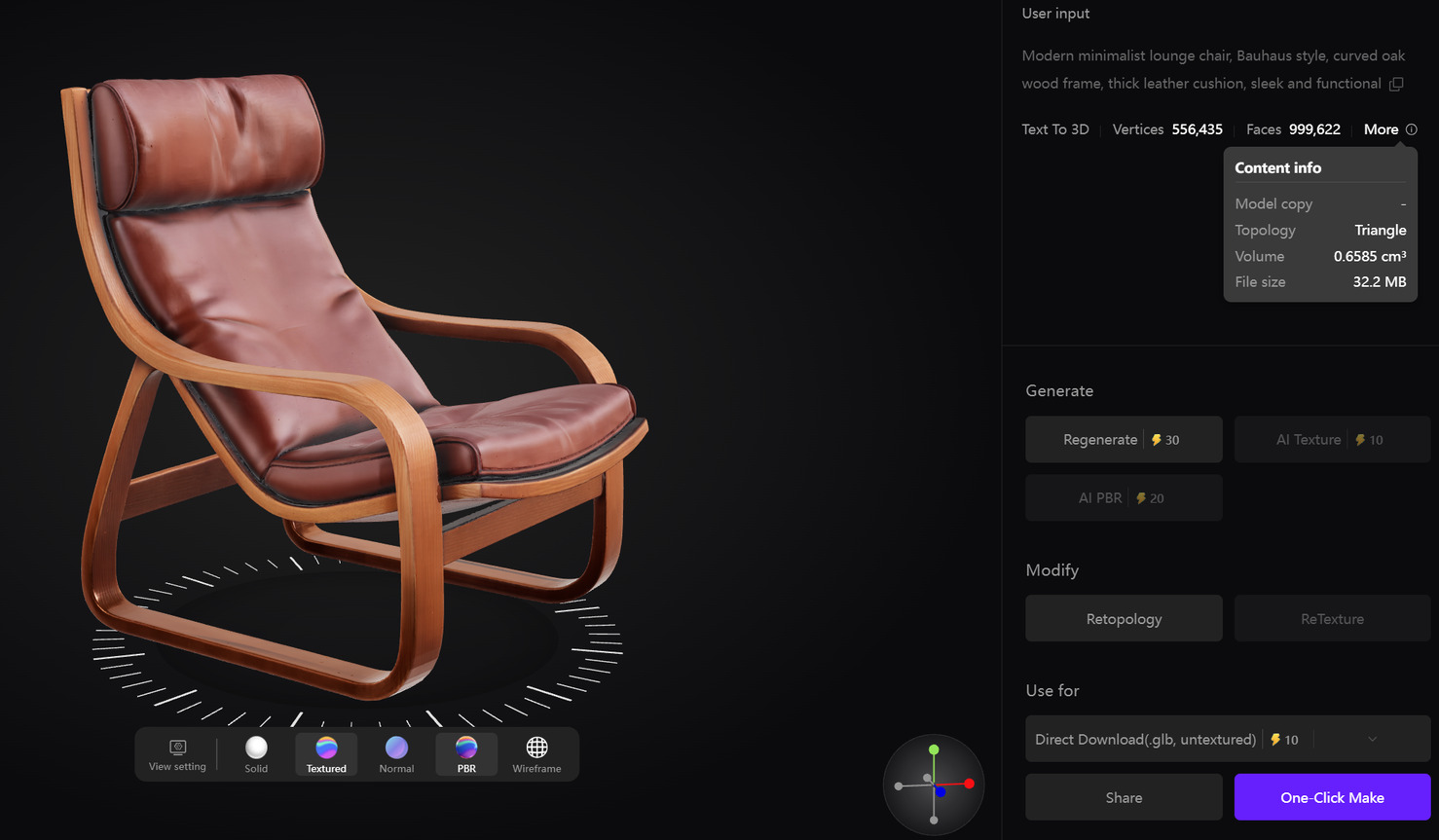
Neural4D’s Direct3D-S2 engine creates watertight geometry optimized for furniture printing.
Neural4D has redefined the professional pipeline by focusing on industrial-grade structural integrity. Unlike generic generators, its Direct3D-S2 engine reconstructs assets from the inside out, making it the premier choice for furniture manufacturing. With native 2048³ resolution and SSA efficiency, it captures micro-details with 3.9x faster performance.
- 2048³ Ultra-High Resolution: Industry-leading detail with guaranteed watertight structures.
- Neural4D-2o Conversational Editing: Refine shapes through natural language prompts.
- Industrial API: Built for high-concurrency automated production.
✓ What We Liked
When I import a Neural4D model into Blender, the edge flow is consistent enough that the armature binds cleanly on the first attempt. For a furniture piece with rounded legs and joinery details, that translates directly into zero retopology time before sending to the slicer. No other tool in this list matched that on a structural component.
− Limitations
The free tier has a monthly generation limit, which is fine for evaluation but not for high-volume production workflows. Organic characters with fine surface detail (hair, skin pores) are also better served by Rodin , Neural4D’s strength is hard-surface and structural geometry.
Tripo AI: Speed & Concepting Specialist
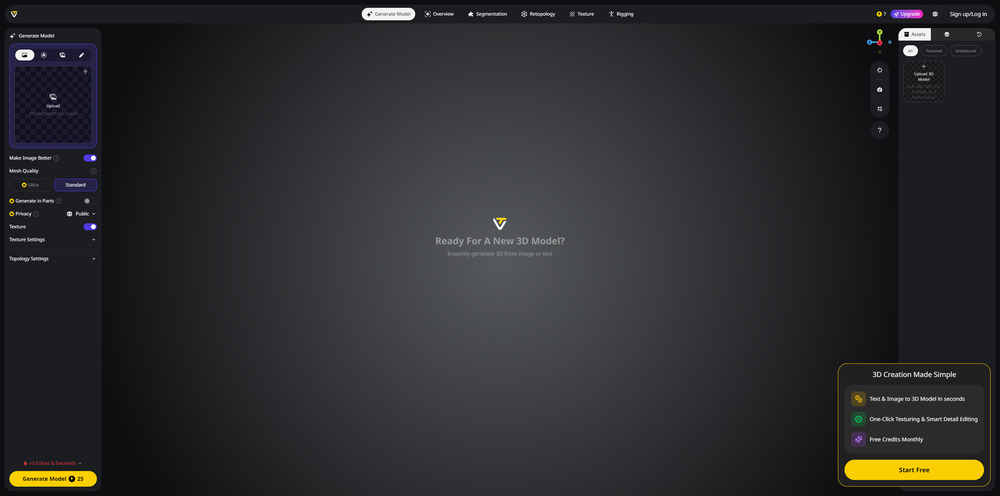
Tripo AI v3.1 generates rapid stylized concepts in seconds.
Tripo AI v3.1 remains the speed champion. Their Smart Mesh P1.0 technology generates clean, low-poly topology in just 2 seconds. It is the perfect bridge for mobile games where polygon budgets are tight.
- Sub-10 Second Inference: Fastest engine for instant Image-to-3D previews.
- Refined Control: Advanced options for mesh simplification and PBR maps.
✓ What We Liked
For game concepting, 2 seconds per generation changes the workflow entirely , I can iterate through 20 silhouettes in the time it takes most tools to finish one. The low-poly output also integrates directly into Unity without a decimation step, which matters when you are on a mobile polygon budget.
− Limitations
Speed comes at a cost: the mesh density is optimized for game-ready assets, not manufacturing. Complex curved surfaces lose definition compared to Neural4D or Hitem3D. If you need a watertight mesh for a slicer, Tripo requires post-processing.
Rodin (Hyper3D): Photorealism Leader for Hero Assets
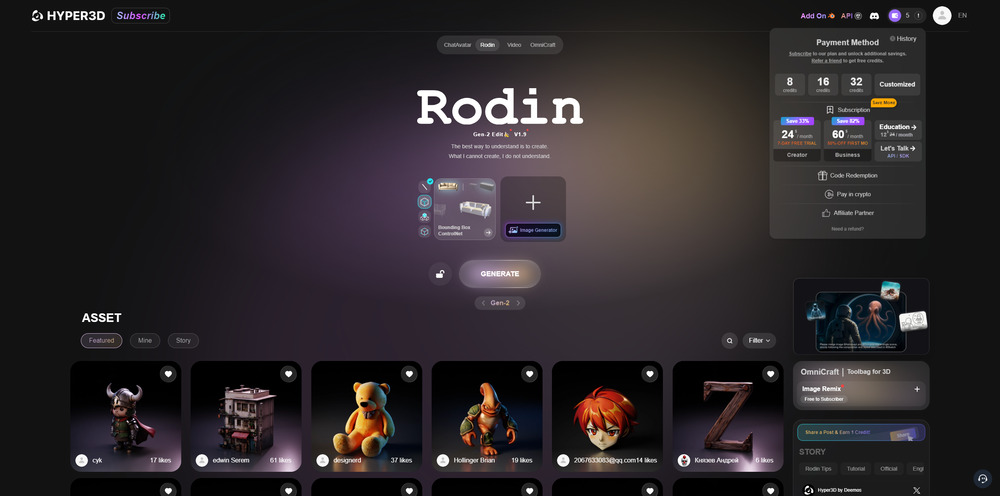
Rodin excels at creating cinematic-grade neural rendering for hero assets.
Rodin leads the market in photorealistic hero assets. It uses neural rendering specifically optimized for biological textures, making it a favorite for digital humans and organic creatures.
- Neural Rendering: Industry-leading facial reconstruction and skin textures.
- High-Res PBR Maps: Automatic generation of displacement maps from a single photo.
✓ What We Liked
The PBR displacement maps Rodin generates from a single reference photo are the closest I have seen to hand-authored textures from an AI tool. For a cinematic character with subsurface skin and eye wetness, this cuts a texture artist’s workload from two days to under an hour.
− Limitations
Rodin is built for hero assets, not bulk production. Generation times are longer than Tripo, and the free trial cap limits testing. Hard-surface objects (furniture, machinery) also produce less impressive results , this tool peaks on organic, biological subjects.
Spline: Interactive Web 3D Powerhouse
Spline has revolutionized the web UI sector by exporting models directly as React components. It eliminates the technical barriers between 3D design and web development, allowing designers to add interactive 3D icons with zero coding required.
- Zero-Code Interactivity: Add events and physics to AI models directly in-browser.
- Native Web Export: Ready-to-deploy Three.js code.
✓ What We Liked
Spline is the only tool in this list where the output is the final deliverable , no export pipeline, no engine import, no additional optimization step. For a product landing page hero section, generating a rotating interactive icon and embedding it as a React component in an afternoon is genuinely faster than commissioning a traditional 3D render.
− Limitations
Spline is purpose-built for web UI, which means it is the wrong tool for anything that needs to leave the browser. There is no meaningful path from a Spline asset to a 3D printer or a game engine. If your pipeline involves Blender, Unity, or a slicer, Spline is not in scope.
Hitem3D: Industrial & 3D Printing Pro
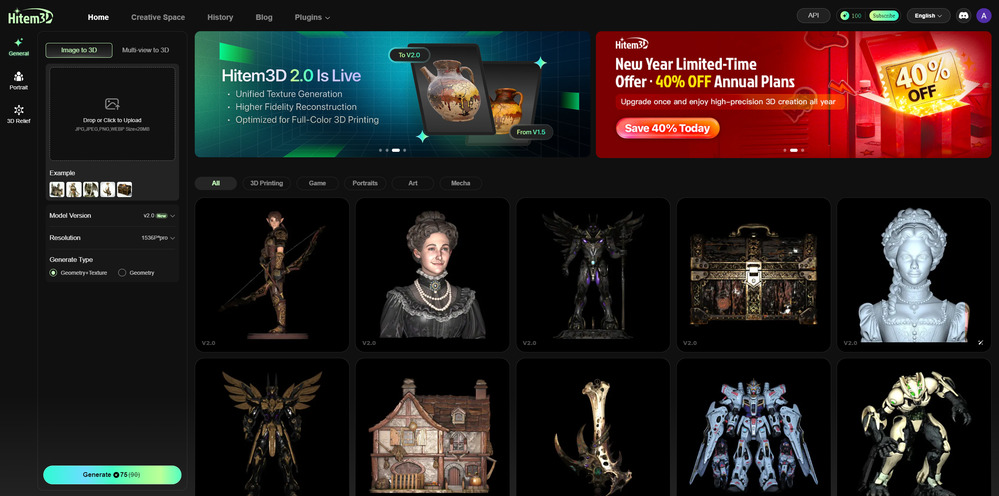
Hitem3D ensures manufacturing readiness for professional 3D printing.
Hitem3D is a powerhouse for manufacturing and structural soundness. Utilizing its Sparc3D algorithms, it delivers 1536³ resolution meshes that are structurally verified for slicers like Bambu Studio.
- Production Focus: Emphasizes watertight, manifold meshes for printing.
- Dynamic Topology: Define polygon counts for lightweight or high-density needs.
✓ What We Liked
Hitem3D is the only tool besides Neural4D that treats slicer compatibility as a first-class output requirement rather than an afterthought. Loading a Hitem3D mesh into Bambu Studio produces zero repair warnings on mechanical parts , something that typically requires a manual pass through Meshmixer with outputs from other AI generators.
− Limitations
The 1536³ resolution ceiling is a real constraint for large-format prints where fine surface detail matters at scale. Organic and character assets are also outside Hitem3D’s strength zone , its optimization pipeline is tuned for hard-surface and mechanical geometry.
CSM: World-Model Approach for View Consistency
CSM focuses on world-model consistency, excelling at multi-view generation. If you have an image from a unique angle, CSM is often better at “guessing” the back of the object, providing consistent assets from 2D character sheets.
✓ What We Liked
For concept art pipelines, CSM solves a specific problem that other tools do not: generating a consistent 3D asset from a character sheet where each view was drawn at a different angle. The world-model approach means the side profile and back view actually agree with each other geometrically, which saves significant correction time downstream.
− Limitations
CSM is a specialist tool for multi-view consistency, not a general-purpose generator. Single-image inputs produce average results compared to Tripo or Rodin. The free tier is also restrictive enough that meaningful evaluation requires a paid plan.
Stable Fast 3D: Open Source Choice for Local Power Users
Following the sunsetting of Luma Genie in January 2026, Stable Fast 3D has emerged as the premier open-source choice. It allows users to run generations locally on their own GPU, making it the ultimate Meshy alternative free of subscription costs.
2026 Newcomers: TRELLIS 2 & Hunyuan3D Worth Testing
Two open-source releases in late 2025 and early 2026 have changed the landscape for users who want production-grade geometry without a subscription.
TRELLIS 2 (Microsoft Research) uses a structured latent representation that generates 3D assets with clean production geometry in a single pass. Unlike most AI models that require manual topology cleanup before pipeline use, TRELLIS 2 outputs are structured for direct import into DCC tools. It runs locally on an NVIDIA GPU with 16GB VRAM and is available on GitHub under MIT license.
Hunyuan3D 2.0 (Tencent) separates geometry generation and texture generation into two distinct stages, producing native PBR material maps alongside the mesh. For users who previously spent time in Substance Painter baking maps from an AI base mesh, Hunyuan3D 2.0 outputs albedo, roughness, and metallic maps in one generation cycle.
Neither tool currently matches Neural4D’s structural guarantees for manufacturing (watertight output is not guaranteed by default), but for general-purpose creative work and open-source pipelines they are the most significant additions to the Meshy alternative category since 2025.
Part 4: FAQ , Common Questions
Q: Is Luma Genie still available in 2026?
A: No. It sunset on January 1, 2026. Migration to Neural4D or Rodin is recommended.
Q: Is there a completely free online Meshy alternative?
A: Yes. Most tools offer free trials or tiers. Stable Fast 3D is fully free and open-source for local use.
Q: Which tool is best for furniture 3D printing?
A: Neural4D is optimized for manufacturing, providing the 2048³ resolution required for physical assets like furniture.
Q: What does ‘watertight mesh’ mean and why does it matter?
A: A watertight mesh has no holes or non-manifold edges. This is critical for 3D printing and physics simulations. Neural4D guarantees watertight output structurally.
Q: Which Meshy alternative has the best API for automation?
A: Neural4D’s Industrial-Grade API is purpose-built for high-concurrency automated production, making it the preferred choice for bulk workflows.
Q: Can I use these Meshy alternatives for commercial projects?
A: Most tools grant commercial use rights under their paid plans. Stable Fast 3D is free for commercial use under its open-source license.
Q: Which tool is best for generating digital humans?
A: Rodin (HYPER3D) is the specialist for high-fidelity digital humans, optimized for biological textures and anatomical structures.
Q: Can I run any of these tools locally?
A: Yes. Stable Fast 3D is 100% open-source and can be deployed on local hardware with a compatible NVIDIA GPU. TRELLIS 2 and Hunyuan3D 2.0 are also locally deployable open-source options.
Q: What are TRELLIS 2 and Hunyuan3D and how do they compare to Meshy?
A: TRELLIS 2 is Microsoft’s open-source structured latent model producing production-ready geometry without post-processing. Hunyuan3D 2.0 is Tencent’s dual-stage model generating native PBR texture maps. Both are strong free Meshy alternatives for users who prioritize open-source access over guaranteed watertight output.
Part 5: Conclusion
Ultimately, choosing the right Meshy alternative depends on your goals. For speed, use Tripo; for web UI, use Spline; for local privacy, use Stable Fast 3D; for open-source production geometry, TRELLIS 2 is worth a serious look. But for industrial quality and perfect geometric structure with 2048³ precision and guaranteed watertight output, Neural4D remains the unmatched champion of 2026.
Find Your Meshy Alternative Today
Try Neural4D’s 2048×2048 resolution and watertight geometry. Free users get 50 credits per week with no credit card required.
Free users get 50 credits per week. No credit card required.