Text to 3D API: The Backend for Infinite Asset Generation
In traditional game development, scale is constrained by assets. Every new environment requires new files, and every variation costs time, money, or both. This is the core limitation of static asset pipelines. No matter how large your asset library becomes, it is still finite.
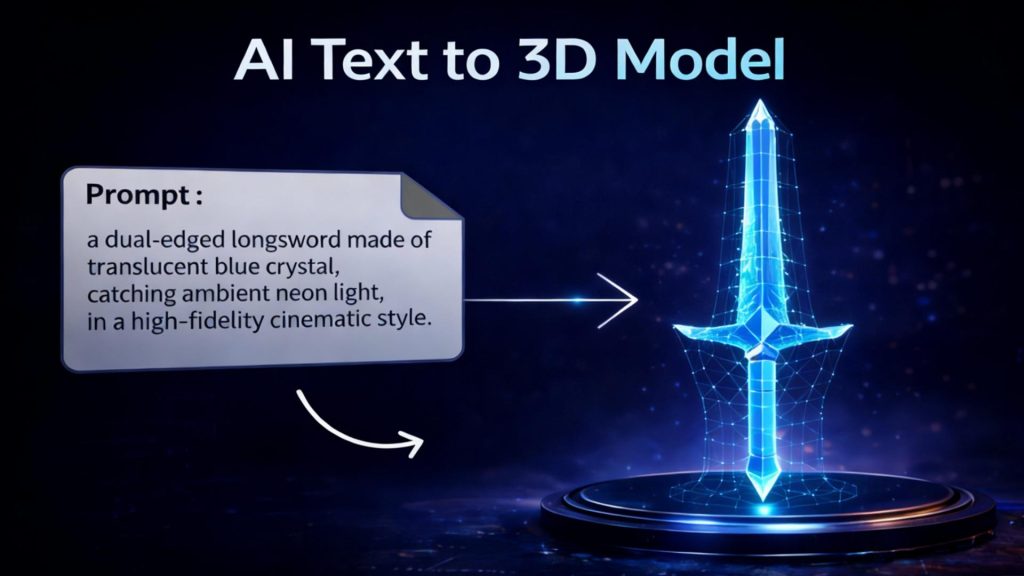
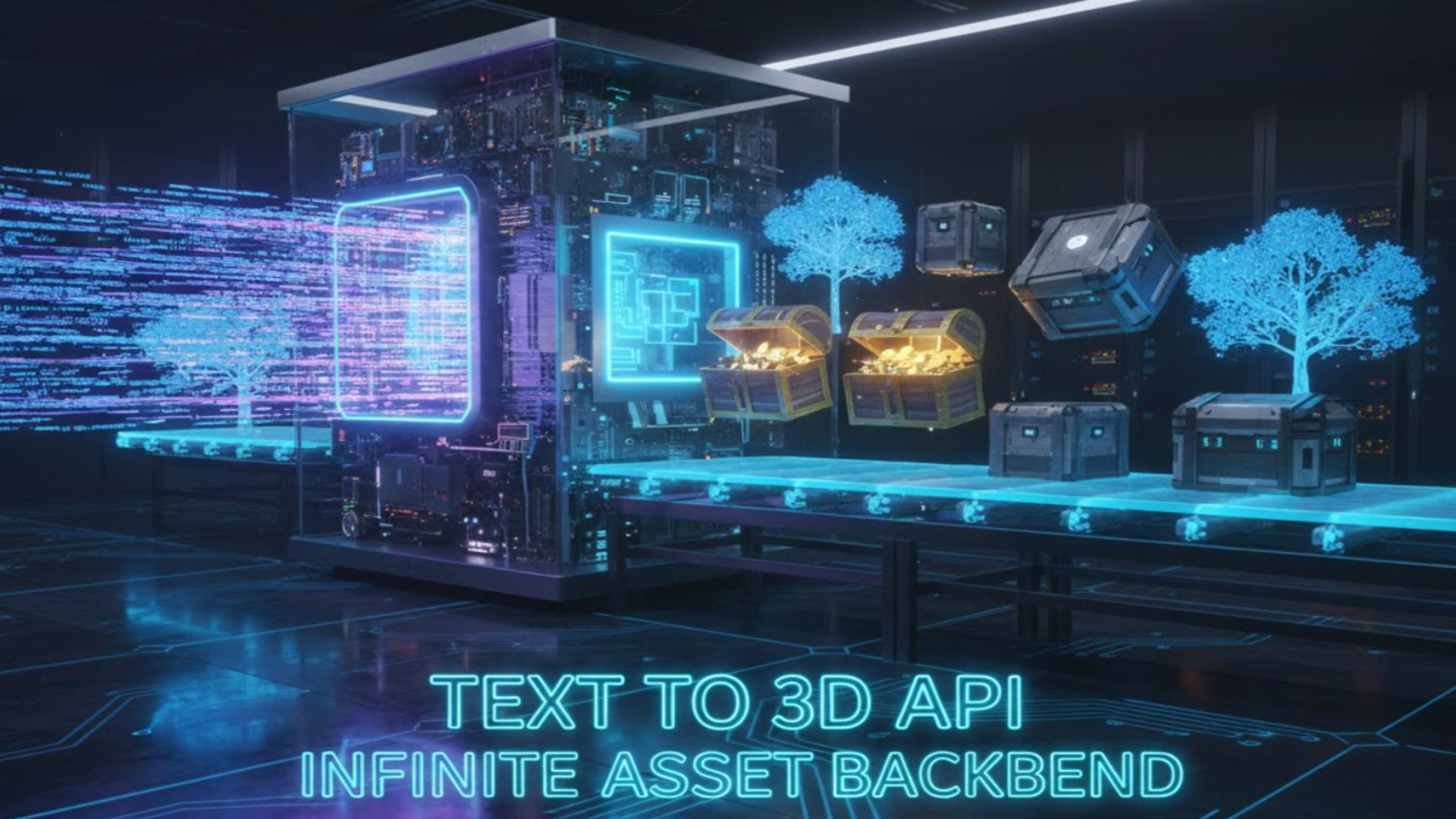
A Text to 3D API removes that ceiling by turning asset creation into a backend capability. Instead of storing predefined files, your system sends a text description and receives a production-ready 3D model in return. In this model, assets are generated on demand rather than retrieved from a folder.
This approach is fundamentally different from reconstructing a specific object from a reference image, which is better handled by an Image to 3D API.
Text-based generation is designed to fill worlds, not match blueprints. It is built for procedural environments, UGC platforms, and systems where volume and variation matter more than exact replication.
Neural4D approaches text-to-3D generation as backend infrastructure. The goal is not novelty, but reliable, engine-compatible geometry that survives real production pipelines.
Table of Contents
From Static Assets to Generative Pipelines
Most game engines today still operate on a file retrieval mindset.
A designer defines a level.
Artists manually create props.
Developers import fixed files into the build. The result is predictable. Every player sees the same crate, the same barrel, the same bench.
A generative pipeline works differently.
❗ Instead of storing assets, the system stores intent.
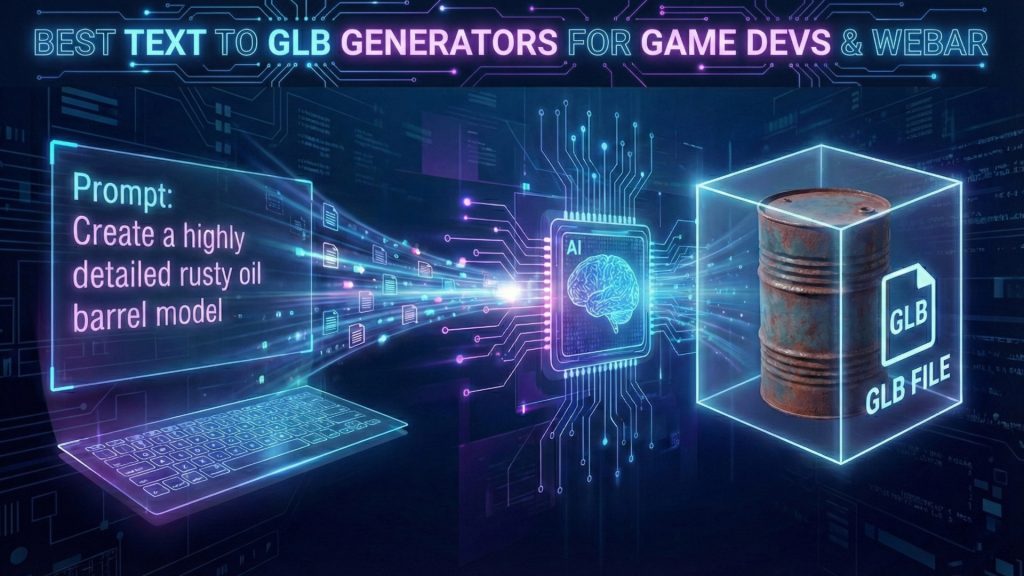
A level script can describe what it needs using text strings such as “rusty oil barrel”, “wooden supply crate”, or “alien artifact with glowing seams”. These descriptors are sent to a scalable text to 3D API, which generates unique assets on demand.
The asset library no longer exists as a folder. It exists as code potential.
This is exactly the design philosophy behind the Neural4D Text to 3D Studio, which exposes text based 3D generation both through UI tools and programmatic pipelines.
For procedural level generation, live service games, and UGC platforms, this shift removes a hard ceiling on scale. Content generation becomes elastic rather than linear with team size.
Neural4D’s text to 3D API is built specifically for these scenarios, where assets must be generated reliably, consistently, and at scale.
Prompt Engineering for Consistent 3D Asset Generation
A common concern with text-driven generation is consistency.
If assets are generated from text, how do you ensure that a chair, a table, and a shelf all belong to the same visual universe?
The answer is not manual review. It is backend logic.
Because a text to 3D model API accepts raw strings, developers can enforce consistency by structuring prompts programmatically rather than passing user input directly.
A common pattern is to define a global style constraint at the server level. This constraint is concatenated to every request before it is sent to the API.
Material type, shading style, polygon density, and texture resolution can all be enforced automatically.
Consistency in generative systems does not come from randomness.
It comes from constraints. This is why text to 3D generation works best when treated as an engineering problem rather than an artistic one.
Neural4D’s generation pipeline is designed around this assumption, making it suitable as a production-ready text to 3D backend rather than a one-off creative tool.
The Economics of Text to 3D APIs at Scale
From a technical leadership perspective, the decision to adopt a text to 3D API is ultimately an economic one.
Asset stores solve short-term problems. They do not scale with content ambition.
A typical asset pack costs between $20 and $50. Once purchased, the assets are fixed. They cannot adapt to context, theme, or gameplay logic. Thousands of other projects use the same files.
A backend text to 3D service shifts the cost model entirely.
Neural4D operates on a compute-based pricing model of approximately $0.15 per generation call.
For the cost of a single asset pack, developers can generate over one hundred unique, project specific assets. Each one is tailored to its prompt and exclusive to the project.
There is also a hidden cost to static assets that is often overlooked. Time spent searching libraries, adjusting mismatched styles, and reusing generic props adds friction to production.
📢 With a scalable text to 3D API, you pay for solutions, not storage.
FMI: Neural4D API – Best Text-to-3D & Image-to-3D API for Developers
How the Neural4D Text to 3D API Works
High-fidelity 3D generation is computationally expensive. It cannot be treated as a synchronous request.
Neural4D’s API is designed to be asynchronous by default.
A generation request returns a job identifier rather than blocking the connection. When the model is complete, Neural4D delivers the asset via webhook callback.
This architecture allows developers to trigger hundreds of generation requests without overwhelming their infrastructure. A forest, city block, or dungeon can be generated in parallel, with assets arriving as they are ready.
The output formats include .glb, .fbx, .obj, .stl, .usdz, and .blend, making the API compatible with Unity, Unreal Engine, and web-based 3D frameworks such as Three.js.
For teams building automated pipelines, this asynchronous design is essential.
Why Watertight Geometry Matters in Text to 3D APIs
Automated pipelines fail quickly when geometry is invalid. Non-manifold meshes, open surfaces, and flipped normals can break physics engines, collision systems, and 3D printing workflows.
Every asset generated by the Neural4D Text to 3D API is watertight by design. This makes it suitable for physics simulation, voxelization, destruction systems, and direct import into Unity, Unreal Engine, or Three.js.
This emphasis on topology quality is a direct consequence of Neural4D’s underlying architecture rather than post processing tricks.
When a Text to 3D API Makes Sense, and When It Does Not
❗ A text to 3D API is not a universal replacement for artists.
It excels when variety, scale, and speed are the priority.
It is ideal for environmental props, background assets, UGC content, and procedural systems where uniqueness matters more than exact design fidelity.
It is not designed for hero characters, licensed IP, or assets that must exactly match a predefined concept down to millimeter precision.
Neural4D is explicit about this boundary. The API is built to fill worlds, not to replace character artists or concept designers.
Knowing when not to use generative systems is part of building trust in them.
Conclusion
A Text to 3D API changes how developers think about content.
Assets stop being static files and become generated outputs of logic.
Variety becomes a system property rather than a production bottleneck. By integrating Neural4D as a backend text to 3D model API, developers gain a scalable, production-ready foundation for procedural worlds, UGC platforms, and dynamic experiences.
This is not about replacing creativity. It is about removing constraints.
Start experimenting with the Neural4D Text to 3D API and see how generative pipelines change what your project can scale into.