How to Make 3D Characters for Games: A Fast AI Pipeline
In 2026, the question of how to make 3D characters for games has evolved from a manual craft to a strategic asset management challenge. For indie developers, the greatest hurdle is no longer just coding, but the high cost of 3D character modeling. Traditionally, creating a single game-ready character involved weeks of labor. However, the emergence of AI-powered game development tools has transformed this bottleneck into a competitive advantage. This guide explores the most efficient image to 3D character pipeline, leveraging Neural4D-2.5 and the Direct3D-S2 algorithm to collapse months of work into a single afternoon.
Table of Contents
Solving the Indie Asset Bottleneck with Fast 3D Character Creation
For a solo dev or a small studio, time is the most expensive currency. A standard 3D character design workflow—comprising high-poly sculpting, manual retopology, UV unwrapping, and texture baking—typically demands 40 to 80 man-hours per asset. When your game requires a diverse cast of NPCs or custom 3D character models, this manual approach becomes a scaling nightmare.
To survive in a market that expects AAA visual fidelity, developers must move toward a fast 3D character creation strategy. This means automating the “grunt work” of 3D construction so your creative team can focus on 3D character animation and integration. By treating AI as a “Zero-to-One” foundation, you ensure that your production speed remains a survival metric, not a failure point.
Direct3D-S2: The Architectural Core of AI-Powered Game Development Tools
Neural4D-2.5 is not a mere artistic filter; it is a specialized volumetric reconstruction engine. At its heart lies the Direct3D-S2 algorithm, a 2026 breakthrough in sparse volumetric latent diffusion. Unlike previous tools that produced “bloopy” or hollow meshes, Direct3D-S2 understands the spatial logic of character anatomy.
✅ Volumetric Consistency: It generates high-resolution shapes (up to 1024³) that capture fine structural details.
✅ Unified Design: The framework maintains a consistent sparse volumetric format across all stages, ensuring that the generate 3D models from image process is both stable and geometrically accurate.
✅ Efficiency: Utilizing Spatial Sparse Attention (SSA), the engine achieves nearly 10x speedups in backward passes, making it the fastest professional-grade AI 3D character generator available.
Efficiency Metrics: Traditional Modeling vs. AI 3D Character Generators
To optimize your studio’s efficiency, it is important to quantify the impact of switching to an AI 3D character generator.
| Production Stage | Traditional Manual Workflow | Neural4D AI Pipeline |
| Concept to Base Mesh | 10 – 20 Hours (Blocking/Sculpting) | < 60 Seconds (Automated) |
| Geometry Refinement | Manual vertex pushing | Conversational Semantic Editing |
| Topological Integrity | Manual Retopology often required | Watertight Manifold Geometry |
| Iteration Speed | Days per major design change | Minutes via AI regeneration |
| Skill Requirement | Senior 3D Artist | Technical Artist / Game Designer |
Phase-by-Phase Guide: How to Make 3D Characters for Games
Successfully learning how to make 3D characters for games in 2026 requires a structured approach to AI integration:
Phase 1: Generative Concepting
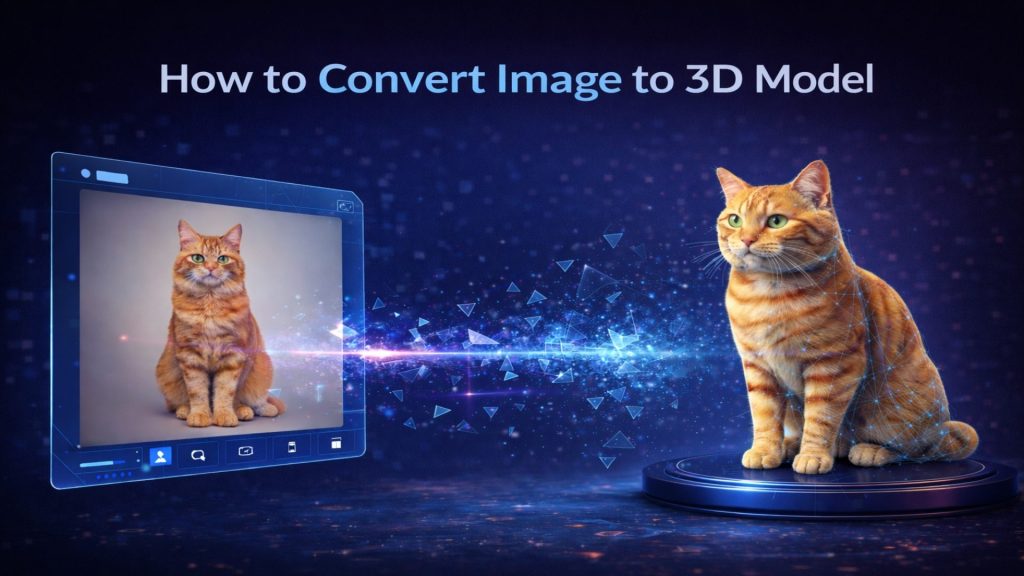
The quality of your 3D model is linked to your 2D input. For the best results, use a character illustration in a “T-pose” or “A-pose” against a clean background. This image to 3D mesh approach allows the algorithm to map joint locations accurately.
Phase 2: Instant 3D Reconstruction
Upload the art to the Neural4D-2.5 suite. This stage effectively replaces the “blocking” and “high-poly sculpt” phases of the traditional character creation process.
Phase 3: Semantic Refinement via AI Commands
Instead of manual sculpting, use the conversational interface. You can type commands like “increase muscular definition on arms” or “adjust leg proportions for animation.” This semantic editing is the most efficient way to make fully fledged 3D characters for games today.
Technical Integration: How to Generate Rigged 3D Characters from 2D Art
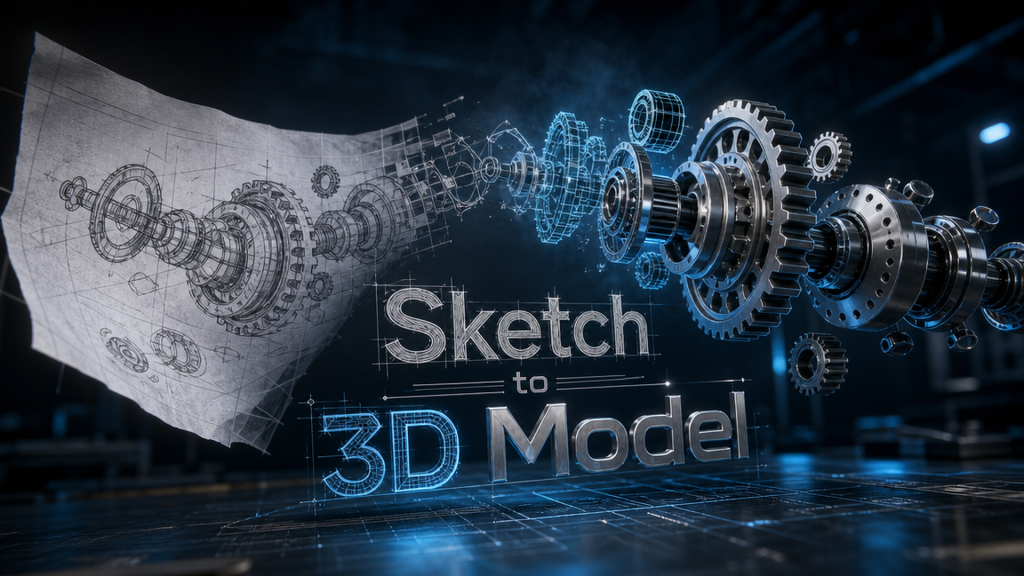
The transition from a static mesh to a moving entity is the most critical phase for any game developer. When you generate rigged 3D characters from 2D art using Neural4D-2.5, the underlying Direct3D-S2 algorithm ensures that the human proportions are mathematically consistent with industry-standard skeletal hierarchies. This spatial accuracy means that exported OBJ or FBX files possess the manifold, watertight geometry required for automatic weight-painting algorithms to function without “mesh tearing.” Consequently, these models are highly compatible with automated rigging suites like Mixamo or AccuRig, allowing an indie developer to go from a flat concept sketch to a fully animated character within Unity or Unreal Engine in under 30 minutes.
Optimization Strategies: Creating Game-Ready Models and LOD Pipelines
To transform raw AI reconstructions into professional game-ready models, developers must implement performance-centric optimization workflows. Neural4D-2.5 utilizes the structural intelligence of the Direct3D-S2 algorithm to ensure that generated assets are not just visually accurate, but computationally efficient.
Rather than delivering a raw, unoptimized point cloud, the system facilitates intelligent mesh optimization. This process prioritizes the preservation of the character’s silhouette and critical joint areas while reducing unnecessary polygon density in flatter regions. This creates a high-fidelity “master mesh” that functions perfectly within an automated low-poly game assets pipeline. By baking high-frequency geometric details into normal maps, developers can maintain the visual depth of a high-poly sculpt while ensuring the asset remains lightweight enough for real-time rendering in dense, populated game environments. This streamlined approach to Level of Detail (LOD) management allows indie studios to hit their performance targets across multiple platforms, from mobile to high-end consoles.
Prototyping at Scale: Creating Custom 3D Character Models for NPCs
The ultimate answer to how to make 3D characters for games at scale lies in the “Archetype Method.” Rather than building every NPC from scratch, developers can use Neural4D-2.5 to generate a handful of core character archetypes. Through conversational AI prompts, you can rapidly iterate on these bases to produce dozens of unique custom 3D character models with varying ages, builds, and styles. This rapid prototyping allows a small team to populate an expansive game world with a diverse cast of characters in a single production day, a feat that previously required a massive AAA art department.
Conclusion: Scaling Your Studio’s Ambition
The answer to how to make 3D characters for games in 2026 is to embrace tools that amplify your creative output. Neural4D-2.5 allows a solo developer to achieve the asset variety of a AAA studio. By automating the mechanical aspects of modeling, you can reclaim your time for what truly matters: gameplay and storytelling.