Decoding Direct3D-S2: The Shift from Reconstruction to N3D
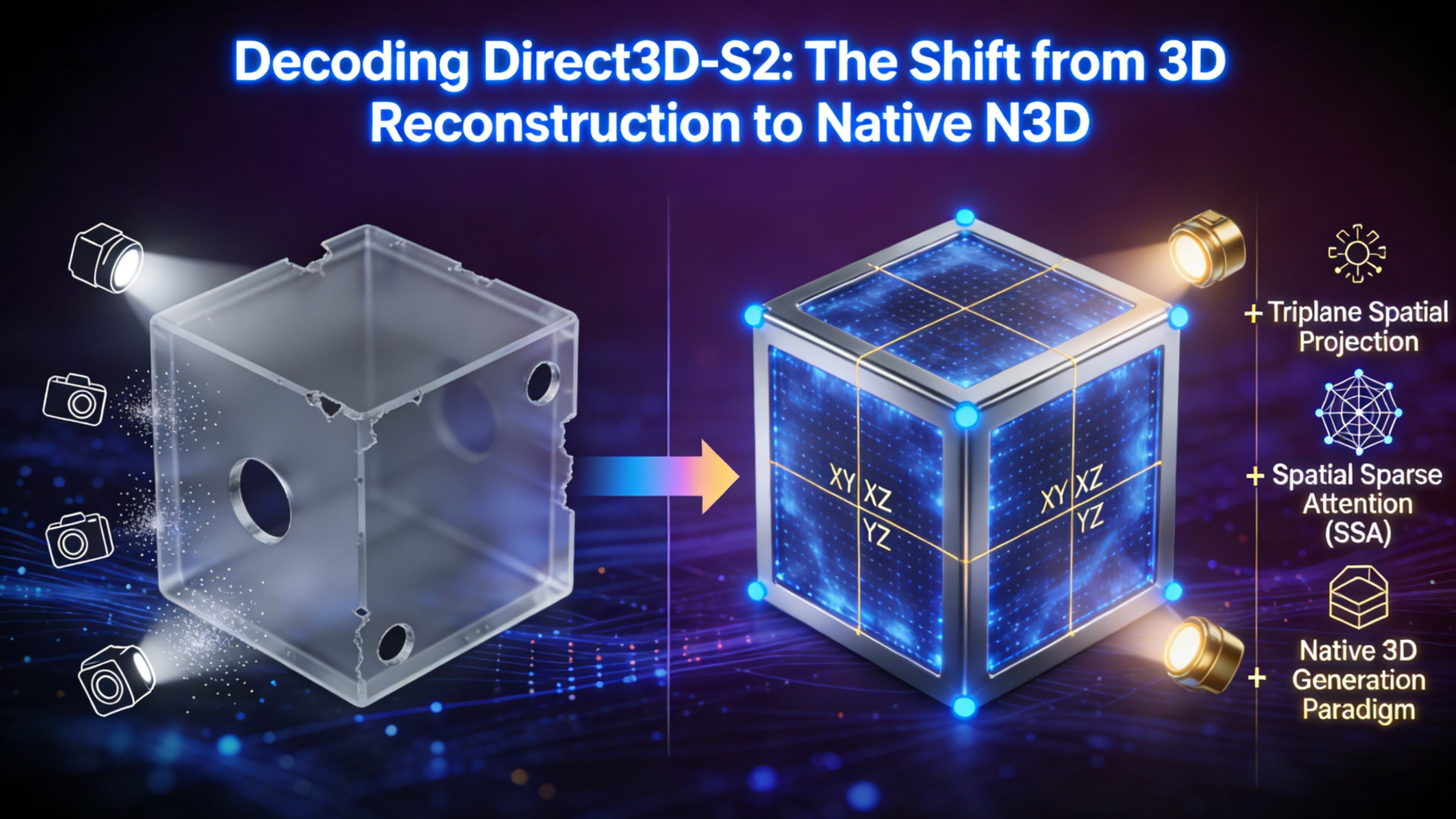
The evolution of 3D content generation is at a pivotal historical turning point. For a long time, the industry relied on technologies such as Multi-View Stereo (MVS) for “geometric reconstruction,” which involves backward-inferring the 3D shape of an object through existing imagery. However, this path has inherent limitations when dealing with weak textures, baked-in shadows, and internal object structures. The emergence of Native 3D Generation has broken this deadlock, marking a transition from “observing and copying” to “understanding and generating.”
Paradigm Shift: From Reconstruction to Native Generation
Traditional 3D reconstruction is essentially a mathematical fitting process. It requires input devices to capture every detail of an object’s surface. If an angle is missing, the model will have holes. In contrast, the N3D Paradigm (Native 3D Generation Paradigm) championed by Neural4D endows AI with a degree of “imagination.”
Under this new paradigm, AI no longer just moves pixels. Instead, it directly generates objects with complete topological structures by sampling from a large-scale latent space. This means that even with limited input information, the system can infer the back features, internal structures, and lighting logic of an object. This shift from “reverse engineering” to “forward generation” is the core value of Native 3D Generation.
Direct3D-S2: The Architectural Foundation of N3D
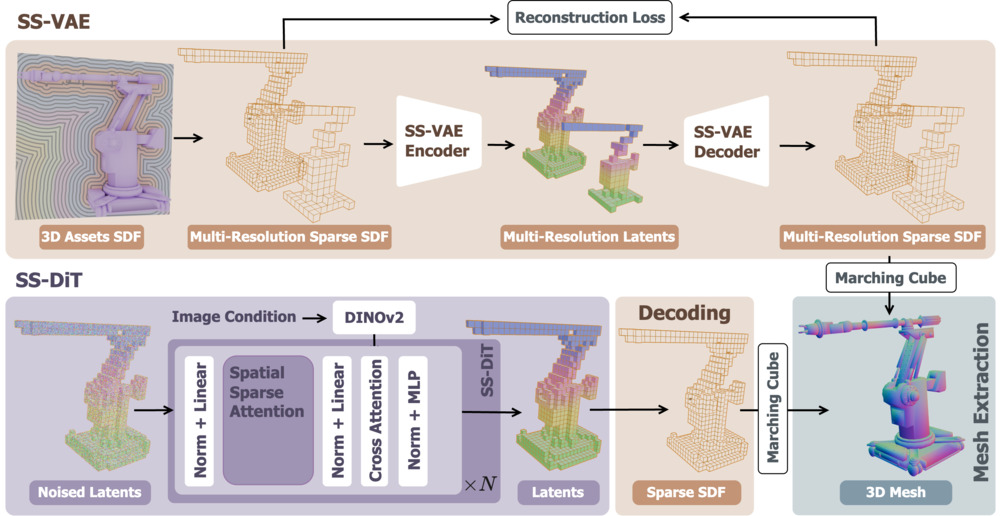
To achieve industrial-grade native generation, Neural4D developed a diffusion model architecture called Direct3D-S2. This architecture abandons inefficient voxel-based direct computation in favor of a more sophisticated spatial feature representation.
🔍The Logic of Triplane Projection
The core of Direct3D-S2 lies in spatial projection and vectorization. The system projects complex 3D objects onto three mutually orthogonal planes (XY, XZ, YZ). Each plane stores not only color information but also rich geometric feature vectors. This “dimensionality reduction” processing retains 3D spatial continuity while greatly reducing computational complexity.
🔍Spatial Sparse Attention (SSA)
In high-resolution modeling, computational bottlenecks usually occur when processing dense spatial data. Spatial Sparse Attention (SSA) is the technical edge Neural4D uses to solve this problem.
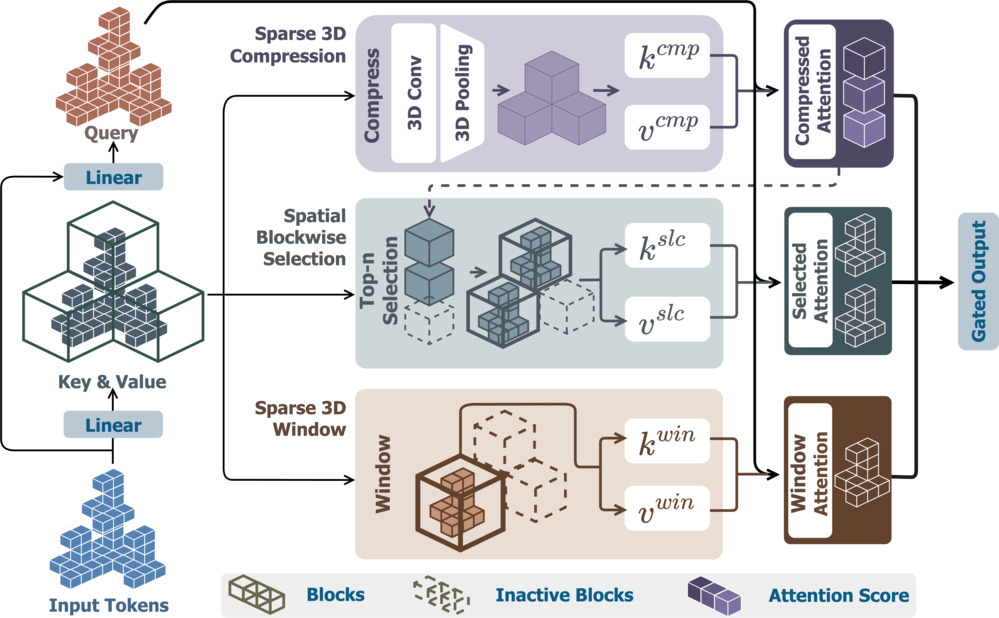
Traditional attention mechanisms calculate relationships between all points in space, which leads to memory overflow at 1024³ resolution. However, Spatial Sparse Attention (SSA) can intelligently identify non-empty regions in space and allocate computational power only to key areas containing geometric features. This sparse processing logic makes it possible to generate high-precision 3D models with sharp edges on mainstream GPUs.
Academic Genes and Technical Complementarity
The success of the Direct3D-S2 architecture is no accident. it stems from the deep integration of Computer Vision (CV) and Computer Graphics (CG). The technical path of Neural4D combines the theoretical depth of Feihu Zhang (from Oxford University) in low-level algorithm optimization with the engineering experience of Yao Yao (the founder of MVSNet) in the field of multi-view geometry.
Yao Yao previously completed early commercial explorations of 3D reconstruction in the HKUST Altizure project. Now, at the Neural4D stage, the team has solved the bottleneck of scarce 3D data in the real world by building an AI synthetic data engine. This leap from algorithmic theory to large-scale data-driven approaches ensures that Direct3D-S2 can generate native models with “physical realism” rather than just visual shells.
Conclusion: Reshaping the Foundation of the 3D World
When 3D models no longer depend on tedious filming and reverse fitting, the threshold for creation will undergo a fundamental change. The Direct3D-S2 architecture proves that native generation is not only theoretically feasible but also possesses extremely high application potential in industrial production.
Through precise control of computational power via Spatial Sparse Attention (SSA) and deep mining of latent space sampling, Neural4D is building a new 3D production standard. In the future, content creators will no longer be “vertex movers,” but creative commanders based on Native 3D Architecture.
Read More: Direct3D-S2: Gigascale 3D Generation Made Easy with Spatial Sparse Attention